



‘Third spaces’: What reassurance in the UAE looks like


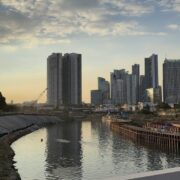
When I moved to Dubai five years ago, one of the things I grew attached to was its generosity of space—particularly its parks.
In urban studies, these are called “third spaces”: places that are neither home nor work, but somewhere in between. Research shows that access to such spaces improves mental well-being, reduces stress, and fosters social connection. Parks lower cortisol levels. Green views steady the nervous system. Even a 20-minute walk outdoors can recalibrate a racing mind.
Those parks quietly ushered in what I now jokingly call my fitness era—not just physically, but mentally.
Running after work. Long walks with friends. Sitting on a bench pretending to cool down but really just watching strangers pass by, each of us briefly sharing the same open air. The parks became proof that life in a city doesn’t have to feel mechanical. It can breathe.
Then the sky changed overnight.
For days, we stayed indoors. We told ourselves we were being cautious, protecting ourselves from whatever might fall from above. News alerts became background noise. Messaging apps filled with updates: “Did you hear that?” “Was that close?” “Are you okay?”
You don’t realize how much you look up at the sky until you’re told not to trust it.
Five days in, I insisted that a friend join me for a walk. There is a concept in psychology called co-regulation—the idea that our nervous systems calm down in the presence of people we feel safe with. I didn’t want to scroll anymore. I wanted steadiness beside me.
So at 6 p.m., I laced up my regular running shoes, put on my Seventeen playlist, and stepped out with a quiet kind of faith—faith in routine, in movement, and that the United Arab Emirates (UAE) government was doing its best to protect its residents.
It was reassuring to read updates that missiles and drones had been intercepted, and that the Ministry of Defence affirmed that the country has one of the most advanced defense systems. But reassurance feels different on the ground.
The park was not empty. Reassurance, I realized, looks like this.
A few of my students spotted me and came running, shouting, and waving as if nothing unusual had happened. Nearby, families were laying out simple iftar picnics on the grass. The ordinary was unfolding in front of me.
Life goes on. I walked another round and realized something: third spaces are not just about greenery or infrastructure. They are about visibility. You see other people continuing, existing, persisting. You borrow courage from ordinary scenes.
The sky above us was the same sky we had feared days before. But under it, people were choosing presence.

Maybe that is what resilience looks like—small acts of normalcy.
I thought about those days indoors. How quickly anxiety narrows your world to four walls and a screen. How the body tightens when all information comes through pixels. In between official advisories were artificial intelligence-generated videos, recycled clips from other conflicts, and vloggers amplifying fear for clicks. The digital noise was relentless, each notification sharpening an invisible edge.
Standing on the grass felt different. Movement returned me to proportion. Community returned me to scale. We are vulnerable, yes, but we are also surrounded.
I loved Dubai’s parks because they made the city feel humane, spacious, and considered. Now they remind me that even when the sky feels uncertain, there are places where we gather without agenda—where we walk in loops not to escape, but to steady ourselves. Where a simple wave can make everything feel, for a moment, okay.
I hope those third spaces remain protected. In the UAE, we are protected from above—and in its parks below, we will keep showing up.
Paul Jeffrey Peñaflor,
Dubai, UAE