





Watery graves, fiery deaths


While heads of governments, international groups and influential personalities are into either waging wars or trying to stop them, thousands of people are into survival mode, dodging bombs, coping with hunger and homelessness, crossing oceans and deserts in search of peace and stability in their lives. One day soon, they hope and pray, they will find a safe place they can call their own. That is, despite the ongoing so-called regional war, a euphemism for a world war-in-the-making.
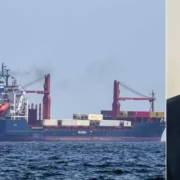
Somewhat out of the media limelight unless a huge tragedy befalls them, are migrants on board decrepit sea vessels who continue to defy dangers by crossing the Mediterranean Sea from Northern Africa to coastline countries in Europe. It is not safe sailing on a small craft on that patch of brilliant blue sea. It is different if one is splurging on a Mediterranean cruise to crow about, relaxing aboard a luxury ship that operates like a high-end hotel with all the creature comforts it can offer.
While bombs from different countries (United States, Israel, and Iran) have been falling on places in the Middle East and sending populations into their fiery deaths (since 2024 in Gaza and more recently in Iran and its neighborhood) countless migrants still bet their lives in order to cross over from hopelessness to hope. Many of them die on the way, but they are not immediately named and reported. They make it to the statistics only later, if at all.
(While writing this, I received a long blow-by-blow account complete with spiritual nuggets from a dear friend and classmate, a Good Shepherd nun, who was on her way back to Rome and was stranded for six terrifying days in Dubai amidst bomb alerts. Filipinos working there made the ordeal so much easier, she said.)
The United Nations International Organization of Migrants (IOM) reported that “at least 7,667 people died or went missing on migration routes worldwide in 2025. IOM’s Director General Amy Pope said: “These deaths are not inevitable. When safe pathways are out of reach, people are forced into dangerous journeys and into the hands of smugglers and traffickers.”
An Associated Press (AP) report a couple of days ago: “Migrants trying to reach Europe are vanishing in droves in what are known as ‘invisible shipwrecks’ but governments responsible for search and rescue are withholding information about what they know. The beginning of 2026 ranks as the deadliest start to any year for people trying to cross the Mediterranean—an unprecedented 682 confirmed missing as of March 16 … but the real death toll is almost certainly much higher.
“Human rights groups are increasingly struggling to verify tolls as Italy, Tunisia, and Malta have quietly restricted information on migrant rescues and shipwrecks along the deadliest migration route in the world.”
In 2024, Pope Francis called “for a renewed and deepened look, capable of embracing the faces and stories of those who cross borders in search of hope” and “a culture of encounter” where people support one another.
Heartrending was the testimony of former domestic worker Loren Capobres before Pope Leo XIV when he visited Lebanon last December. Capobres who now works with Jesuit Refugee Service described the human cost of war, citing cases of refugees and the churches’ role in addressing human suffering. She told the story of how a Sudanese couple were locked up by their employers who fled while the bombs were falling. The couple escaped and walked for three days with their newborn until they reached the church. The Pope listened intently. (The video is in cbcpnews.net.)
Pope Leo is scheduled on July 4 to make a pastoral visit to the Mediterranean island of Lampedusa south of Sicily, a landing point of migrants which is considered a symbol of Europe’s migration crisis. Here, thousands of migrants who brave perilous sea crossings arrive annually. Pope Francis chose Lampedusa for his first visit outside Rome in 2013.

While they figure in diaspora stories that continue to be told, many Filipinos in search of better lives reach foreign shores through regular travel routes and conveyances. We have yet to hear of Filipinos embarking on massive death-defying sea journeys to seek better lives in distant shores. The Philippines has, in fact, been a landing point and host for refugees—the Jews during World War II and those from Southeast Asia, Vietnam particularly, in the 1970s.
I remember the boat Tung An that carried some 2,700 Vietnamese refugees in the late 1970s. The freighter was said to have been initially turned away in other ports and sailed for months before it was allowed in the Philippines. Many of the refugees arrived sick and emaciated. I remember the common remark about those who were super thin or aspired to be: “Parang sa Tung An.” Flattering or not, the ship’s name caught on.
The Vietnamese refugees thrived on our hospitality for years. Many later moved to affluent countries, others stayed for good. Our “culture of encounter” at work.
—————-
Send feedback to cerespd@gmail.com