




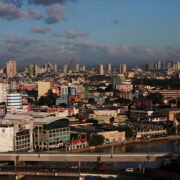



More office space is coming to Cebu, will tenants follow?


Cebu remains the busiest office market outside Metro Manila, and it’s about to get a lot more space to fill.
Our 3Q 2026 data shows Cebu leased 55,000 sqm of office space in the first nine months of the year. Over the next three years, 174,000 sqm of new supply is set to arrive, the largest pipeline of any provincial market.
The question for the next two years is simple: Will tenants arrive as fast as the buildings do?
Where Cebu stands today
Provincial markets accounted for 136,000 sqm, or 18 percent of the 754,000 sqm of office space leased nationwide year to date. Cebu took 40 percent of that provincial total, well ahead of Clark (26,000 sqm) and Iloilo (25,000 sqm).
On its own, Cebu accounts for about 7 percent of all office demand in the country.
The market is also relatively tight. Cebu’s vacancy rate sits at 12 percent or about 188,000 sqm of available space, down from the previous quarter. That’s below the provincial average of 19 percent and Metro Manila’s 18 percent, and on par with Makati CBD. Among provincial markets, only Davao, at 4 percent, is tighter.

A supply wave that comes early
Cebu’s 174,000 sqm pipeline is more than a third of the 474,000 sqm of new office space headed to the provinces through 2028. It’s also larger than the pipelines of Clark (67,000 sqm) and Iloilo (38,000 sqm) combined.
Most of it comes early. About 108,000 sqm is scheduled for 2026, followed by 41,000 sqm in 2027 and 25,000 sqm in 2028. That makes Cebu home to roughly two-thirds of all provincial office space due this year.
Put those numbers side by side and the challenge is clear. The space slated for 2026 alone is nearly double what Cebu leased in the first three quarters. The full pipeline is almost as large as all the vacant space in the market today.
It also helps to remember what the 55,000 sqm measures. That’s gross demand, which counts every lease signed, including relocations. Once vacated space is subtracted, net absorption comes in lower.
Where the next tenants could come from
The national picture gives reasons for confidence. Despite this year’s headwinds, occupiers have largely adapted and kept taking space.
Office take-up rebounded 33 percent in 3Q to 276,000 sqm, the strongest quarter of 2026. Expansions made up 65 percent of deals of 1,000 sqm and above, which we read as continued long-term interest in the market.
IT-BPM remains the engine, and we expect it to stay the largest demand driver through the rest of 2026 and into 2027. Of the 416,000 sqm of office requirements still looking for space nationwide, 206,000 sqm come from IT-BPM, including 98,000 sqm from global capability centers.

Provincial markets account for 53,000 sqm of that live pipeline. IT-BPM firms are also signing early. They make up 98 percent of the 60,000 sqm pre-committed in buildings due in 2028.
Demand also continues to lean toward Philippine Economic Zone Authority (PEZA) accredited buildings, which captured 68 percent of all office space leased nationwide this year.

What it means for occupiers and landlords
For tenants, more buildings mean more choice. Across the market, we continue to see higher-vacancy locations favor tenants, and companies planning a move or expansion in Cebu will have more options in the next two years than they do today.
For landlords, timing is everything. Nationally, most of the space vacated this year came from tenants moving to higher-quality buildings, not leaving the market. As we noted in our 3Q outlook, the pace of recovery will hinge on how quickly live requirements convert into committed deals.
Cebu enters this supply cycle as the country’s leading provincial office market, with the most demand, the biggest pipeline and vacancy below Metro Manila’s. The next few quarters will show whether demand can keep pace with the cranes.
The author is a senior manager of Commercial Leasing at Leechiu Property Consultants Inc.


