







Villar City builds the future-proof case for Metro South


Philippine real estate has learned to thrive under pressure.
It has moved through financial crises, geopolitical tensions, pandemics, natural disasters, and supply chain disruptions, among other uncertainties. Today, the Middle East tensions add yet another layer of risk to business sentiment and development costs.
The economy, however, will not stop moving despite the headwinds. Its segments and sectors—real estate for example—will need to adapt, be strategic, and firmly anchored on fundamentals.

A stronger signal
This is where Villar City’s story gains weight.
In uncertain times, progress becomes a stronger signal than promise. Projects that continue to move forward show confidence and capital commitment. And it’s this same conviction that’s driving Villar City, across its 3,500 hectares spanning 13 towns and cities in Metro South.
Roads are being built. Districts are taking shape. Residential communities are rising. Retail, lifestyle, institutional, leisure, and green spaces are being planned and rolled out as parts of a modern megacity, touted to become Metro Manila’s new center of gravity.
Future proof, complete ecosystem
Villar City is designed to offer a complete urban ecosystem comprising 16 masterplanned districts.
While each district offers future locators and residents a unique character, it leverages on the strength of the whole city, from shared access, complementary uses, to built-in markets and connected infrastructure that allow each area to grow with, and benefit from, the others.
This makes Villar City more future-proof as it is built on multiple drivers of demand—residential communities, commercial hubs, education, leisure, sports, green spaces, and everyday services—creating a city that can adapt as needs change and continue generating activity across different stages of growth.
One example is Evia, which brings retail and dining activity. Here, the Villar Group is constructing the Promenade to complement the lifestyle offering of this district.

Emporia, envisioned as a hub for enterprise and commerce, now has the recently completed Emporia Active Park, an emerging destination that features curated food carts, walkable paths and upcoming street courts for pickleball and badminton. Anchored on a mall-to-market concept, it delivers a modern retail experience designed for interaction amid expansive open spaces.

The adjacent Crescent Commercial Center is further strengthening everyday accessibility. A gasoline station is set to open, alongside popular fast-food outlets and other quick-service restaurants, adding essential services to the expanding grid.
University Town is meanwhile supported by the University of the Philippines’ Technology and Innovation campus, the construction for which is currently ongoing.
New destinations
Leisure and recreation are also part of the city’s investment equation.
Construction is ongoing for The Stadium at Villar City, a state-of-the-art sports complex spanning 30,000 sqm, and the planned golf courses—new destinations poised to draw people in for sports, events, tourism, and premium lifestyle experiences.
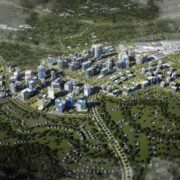
There are also cafes and pocket gardens which will further improve livability in this megacity, creating a place where people are more likely to stay. And where people stay, businesses follow. Where businesses follow, land values gain stronger support.
A permanent market
This is where the residential pipeline becomes critical. Beyond adding homes, it builds the most important layer of any urban development: a permanent market.
Villar Group’s residential brands like Brittany and Crown Asia are actively offering new communities in Villar City. Portofino continues to anchor the premium segment, exemplifying masterplanned living at scale.


Upcoming enclaves—including Brittany’s Elara and Ardenne, Crown Asia’s Pontello and Novus Prime Residences—are poised to further diversify the residential mix. At the high end front, land development and activations are advancing in Forresta, Brittany’s ultra-luxury enclave.
Connectivity further helps everything work more seamlessly. The 18-km Villar Avenue serves as the development’s main spine, linking districts and allowing movement across the estate.
In a project of this scale, a road becomes an economic tool, shaping where people go, where businesses locate, how services reach communities, and how value spreads across the city.
Indeed, Villar City’s ongoing development amid uncertainties turns resilience into something visible. And in real estate, few signals are stronger than progress on the ground.


