










While BGC booms, Makati stabilizes: Reading the new Metro Manila office hierarchy

Metro Manila’s office market continues to build momentum. Recovery, however, is playing out unevenly, and that’s bringing renewed attention to the future of the city’s aging office stock.
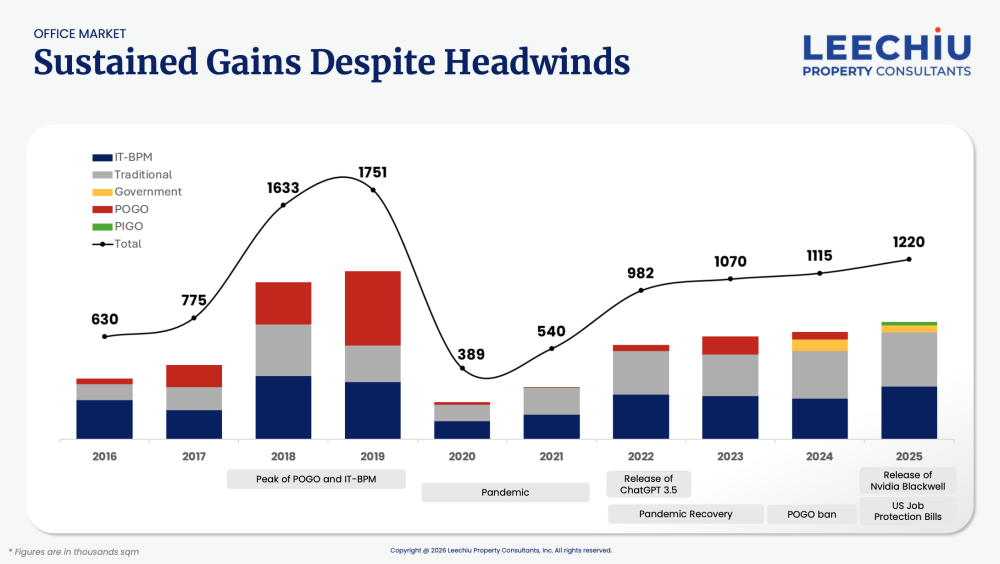
Office take-up reached 1.22 million sqm in 2025, up from 1.115 million sqm the prior year, marking sustained gains despite headwinds from the ban of Philippine offshore gaming operators (Pogos), US job protection bills, and the rapid evolution of AI.
Nationwide vacancy stands at 18 percent across 3.4 million sqm of available space, while Metro Manila registers 17 percent at 2.6 million sqm. These figures, while still elevated, reflect a market that is steadily finding its footing.
A two-speed recovery
Demand patterns tell a clear story.
Occupiers are gravitating toward newer Grade A spaces with large contiguous floor plates, sustainability credentials, and locations that support talent attraction.
Bonifacio Global City (BGC) led all districts in 2025, posting a 73 percent year-on-year (YOY) surge in take-up to 218,000 sqm, with IT-BPM firms accounting for 38 percent of demand. BGC’s vacancy tightened to just 8 percent, while Makati still carries a 15 percent rate across 591,000 sqm of available space.
IT-BPM remains the backbone of office demand, and the sector’s trajectory is encouraging.
Revenues grew 5.3 percent to $40 billion in 2025, with forecasts pointing to $42 billion in 2026. Provincial markets are also contributing meaningfully, with Cebu accounting for 55 percent of provincial take-up at 150,000 sqm, up 33 percent YOY.
Still, the widening gap between modern and older stock is pushing owners and investors to think more strategically about what comes next for aging assets.
The case for repurposing
According to our research, the office supply pipeline is expected to thin considerably after 2026, creating a favorable window for repositioning.
Rather than adding new stock into a market still absorbing existing inventory, owners may find better risk-adjusted returns in adaptive reuse.
Converting older offices into retail, mixed-use, flexible workspace, hospitality, or data-related facilities is gaining serious traction.
This approach gets assets back to productive use faster and at lower capital cost than ground-up redevelopment. It also aligns with evolving demand patterns as retail and experiential formats regain momentum across the metro.
From a capital markets perspective, preserving stable income streams has become more valuable than chasing headline rents on speculative new builds. Adaptive reuse can stabilize cash flow and improve long-term bankability while the broader office market continues its recovery.
When redevelopment still works
There are clear scenarios where new supply remains the right call.
Prime sites in BGC or core Makati with limited future pipeline, buildings capable of delivering true Grade A specifications, and long-term capital holders with the balance sheet to absorb development risk can still justify redevelopment.
As newer supply becomes scarcer beyond 2026, well-located new builds stand to benefit from tightening conditions.
The cost of standing still
The least productive path is inaction.
Buildings that remain functionally obsolete risk seeing vacancies climb further, rents compress, and competitiveness erode. Over time, that deterioration affects not just income but exit value, a compounding challenge that only becomes harder to address with delay.
Strategy over sentiment
The decision between adaptive reuse and redevelopment should be driven by location fundamentals, building condition, capital structure, and a realistic reading of demand, not by assumptions carried over from pre-pandemic expansion cycles.
The market has evolved, and portfolio strategy should evolve with it.
With the office sector on a steady upward trajectory, the next chapter will likely be defined not by how much new space gets built but by how thoughtfully the existing stock is reimagined. The opportunity is there for owners willing to act.
The author is senior manager of Commercial Leasing at Leechiu Property Consultants