





Trump, Xi dial down trade war

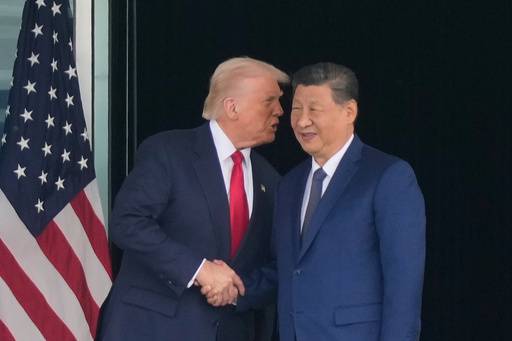
President Donald Trump claims that America has increasingly profited from trade with China, largely playing down the tensions over rare earth minerals, tariffs, and emerging technologies such as artificial intelligence (AI) that could rupture relations between the world’s two largest economies.
Trump departed on Tuesday for a summit in Beijing with Chinese leader Xi Jinping, in what could potentially be the first of four meetings this year.
“We’re doing a lot of business with China and making a lot of money,” Trump said last week. “We’re making a lot of money—it’s different than it used to be.”
The summit is primarily about keeping the economic relationship stable, with only modest policy announcements expected. A trade truce reached last October likely will be extended, while China may announce plans to buy American soybeans, beef, and Boeing airplanes.
US officials also have teased the creation of a Board of Trade to keep the sides talking on economic issues.
Trade imbalance
Engagement would only be the first step toward addressing the competition between the US and China, as tit-for-tat tariffs, the AI and electric vehicle buildout, and the Iran war could upend relations.
Despite Trump’s claims about making money, China bought nearly $50 billion less in American products last year than it did in 2022, according to US Census Bureau data.
Some of that decrease reflects Beijing stopping soybean purchases during last year’s trade war. The Trump administration has made clear that it wants to support American farmers and factories by having China import more from the US, with the goal of further narrowing a trade imbalance that totaled $202 billion last year.
The US also now imports more goods from Taiwan than China, a change provoked in part by the AI race that has US firms buying computer chips and servers from the self-governing island.
Share of goods
China’s share of goods imported to the United States has fallen from 22 percent at the start of Trump’s first term in 2017 to just 7.5 percent in the first three months of this year, according to government data analyzed by Chad Bown, a senior fellow at the Peterson Institute for International Economics and coauthor of the book “How to Win a Trade War.”

In some ways, Trump’s and Xi’s governments have been talking past each other. Trump assumes America can keep its edge on AI, so he judges the trade imbalance as the big issue to solve.
But Xi sees a world disrupted by climate change and the Iran war, shifts that could give a boost to Chinese technologies such as solar panels and EVs.
Several potential strains could easily upset the cheery talk of friendship—raising questions about whether any meaningful progress can be made at the summit on issues like: China’s control of the majority of rare earth mining and almost all of the processing for those minerals widely needed for electronics; the US push to limit China’s access to the most advanced computer chips; China’s dominance as an automaker; Trumps tariffs; and US sanctions on a Chinese oil refinery and dozens of tankers and shippers for involvement in transporting Iranian oil.
The countries are also jousting over management of the Panama Canal.


