











Dutch banking giant ING can’t live without the Philippines

For most retail customers in the Philippines, the name ING disappeared more than two years ago, when the Dutch bank closed its local consumer banking business.
But the company never really left.
For ING Bank, the Philippines remains an important part of its global operations—deeply embedded in the grand machinery that keeps the global bank running across continents.
ING continues to operate a sizeable wholesale banking business in the Philippine while hosting service centers that support operations abroad. These teams handle financial markets processing, lending support, as well as trade and finance services for several ING branches across Asia.
At the heart of this are the company’s “ING hubs,” internal service centers that deliver nearly 300 functions to about 40 countries in the bank’s global network. The hubs support retail banking operations, wholesale banking products, banking technology, financial crime and fraud prevention, risk and finance services, data analytics, legal work and centralized people services.
The operations employ roughly 7,000 people in the Philippines, forming a key part of the bank’s global workforce of about 65,000.
As the financial industry undergoes rapid technological change, ING is also preparing its Philippine teams for the next phase of banking—including the growing use of artificial intelligence (AI) in areas such as risk management, fraud detection and data analysis.
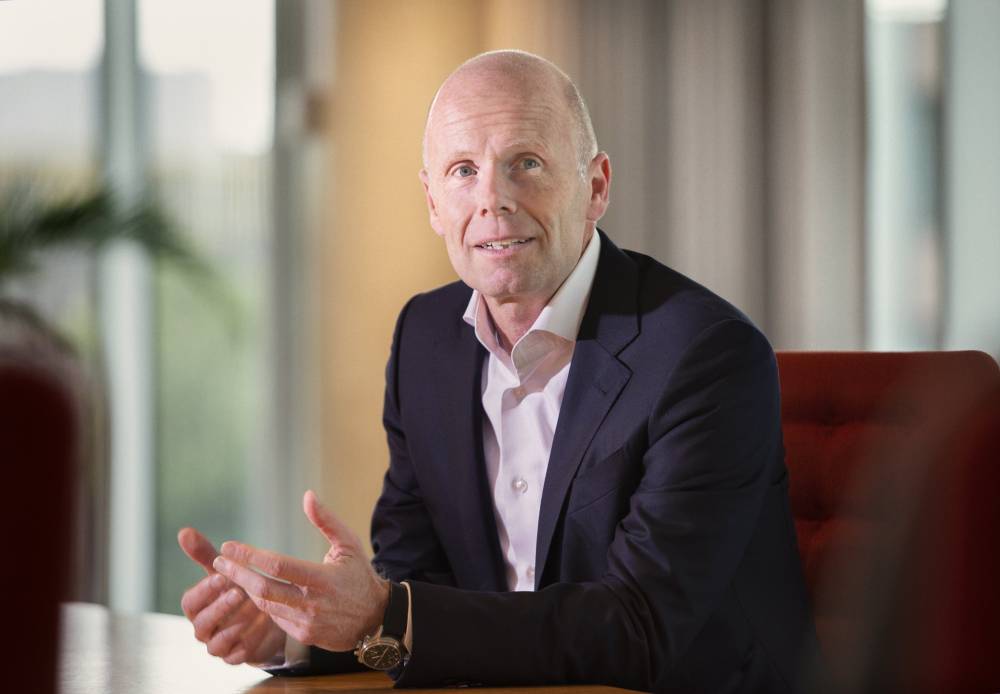
“So, we have grown beyond what we expected originally,” Marnix van Stiphout, ING’s chief operating officer and chief transformation officer, tells the Inquirer.
“And I think the game—if it is a game, which it isn’t, obviously—for the next period is maybe not so much to grow it, but to bring even more meaningful work to the colleagues that we’ve got here in Manila,” Van Stiphout adds.
His remarks suggest the bank is unlikely to add more hubs beyond its two existing locations in Makati and Bonifacio Global City. Instead, ING is focusing on expanding the scope and complexity of work handled by its Philippine teams.
That includes preparing them for the bank’s broader push into AI.
Globally, ING is deploying generative AI in several areas: personalizing marketing, improving chatbots and straight-through processing for customer service, strengthening know-your-customer and compliance checks, accelerating software engineering, alongside supporting wholesale clients in lending and sustainability work.

In the Philippines, Van Stiphout says teams already handle complex functions, such as antimoney laundering monitoring and data management —roles that may be complemented by AI tools rather than replaced by them.
And the training has already begun.
“We have got dedicated AI learning education for all of our people, for the leadership, but also for all of our people,” he says. “That includes everybody in Manila, too.”
Looking ahead, Van Stiphout acknowledges the labor displacement fears surrounding AI. But he says ING continues to value the depth of talent it has built in the Philippines over the years.
“We couldn’t live without the Philippines. Let’s be clear about this,” he says. “And we don’t want to live without the Philippines.”
“It is just a very good place for us to be,” he adds.