



PH Q1 palay output down 6.3% to 4.4M MT

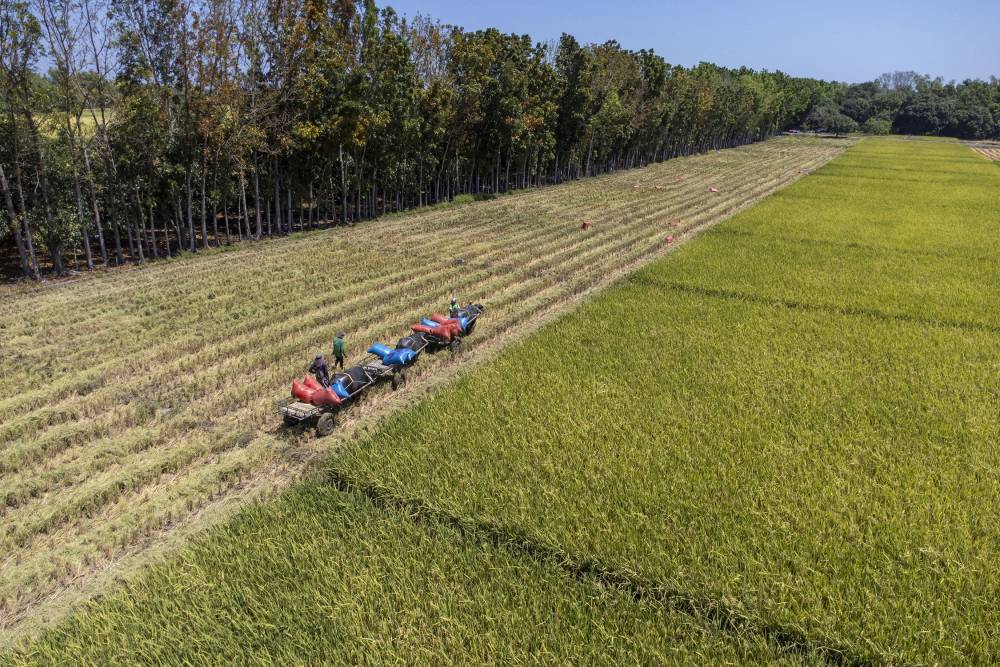
Local palay production dropped 6.3 percent in the January to March period to 4.4 million metric tons (MT), the lowest first-quarter output since 2020 due to the lingering impact of typhoons that hit the country late last year, as well as damaged irrigation systems, according to the Philippine Statistics Authority.
Agriculture Secretary Francisco Tiu Laurel Jr. added that softer farm-gate prices prior to the government’s temporary rice import restrictions from September to December 2025 also discouraged planting.
Central Luzon was the leading palay producer in the first quarter with a share of 18.8 percent, followed by Western Visayas and Cagayan Valley with 10.2 percent and 9.6 percent, respectively.
The statistics agency said the three regions accounted for 38.6 percent of overall production.
With the lower palay output, the Philippines imported 1.68 million MT of rice from January to April, 18.3 percent more than the 1.42 million MT recorded in the same period last year, data from the Bureau of Plant Industry showed.
Vietnam remained the country’s leading source of imported rice with a market share of 86.73 percent. It exported 1.46 million MT of rice in the first four months of 2026.
Thailand came in second with a 6.2-percent share, followed by Myanmar with 4.3 percent and Cambodia with 2.12 percent. Other suppliers were Pakistan, India, South Korea and Italy.
The DA said early this month it was considering limiting monthly rice import volumes from June to August this year as part of efforts to ensure stable supply at affordable prices while helping rice farmers earn from their output.
“The objective is to prevent a price collapse while ensuring adequate domestic supply,” DA earlier said.
Tiu Laurel stressed that imports were still needed but that bringing in rice from abroad should be carefully managed to avoid further depressing local prices.
He noted that earlier import controls helped ensure that about 70 percent of the local harvest was sold at favorable levels for the farmers and consumers.
But even with these controls, the Philippines is expected to remain the world’s largest rice importer for the fifth straight year in 2027, as the growing population increases demand for the household staple amid low global prices, according to the US Department of Agriculture (USDA).
The USDA’s Foreign Agricultural Service (USDA-FAS) projected the country’s rice imports to reach 5.6 million MT in 2027, a 1.8-percent rise from 5.5 million MT in 2026.
“The Philippines continues to lead as the largest importer on population growth and food use increases underpinned by global prices that remain low,” the USDA-FAS said in a report.

On a regional basis, the foreign agency said rice imports in Southeast Asia were seen to continue rising, albeit at a slower rate, while East Asian imports are anticipated to drop because of the reduced demand from Japan.
The USDA-FAS said Vietnam would become the second-largest rice importer worldwide, with its overseas rice purchases estimated at 4 million MT.
The Southeast Asian country will primarily source paddy rice from Cambodia.
“Tight domestic supplies spur more demand for Cambodian paddy rice,” it added.
Following the Philippines and Vietnam are China (3.3 million MT), Nigeria (2.9 million MT) and the European Union (2.35 million MT), ranking as third to fifth largest rice importers worldwide.
******
Get real-time news updates: inqnews.net/inqviber