








Chandeliers made of rice, guts, and rust light up Filipino power

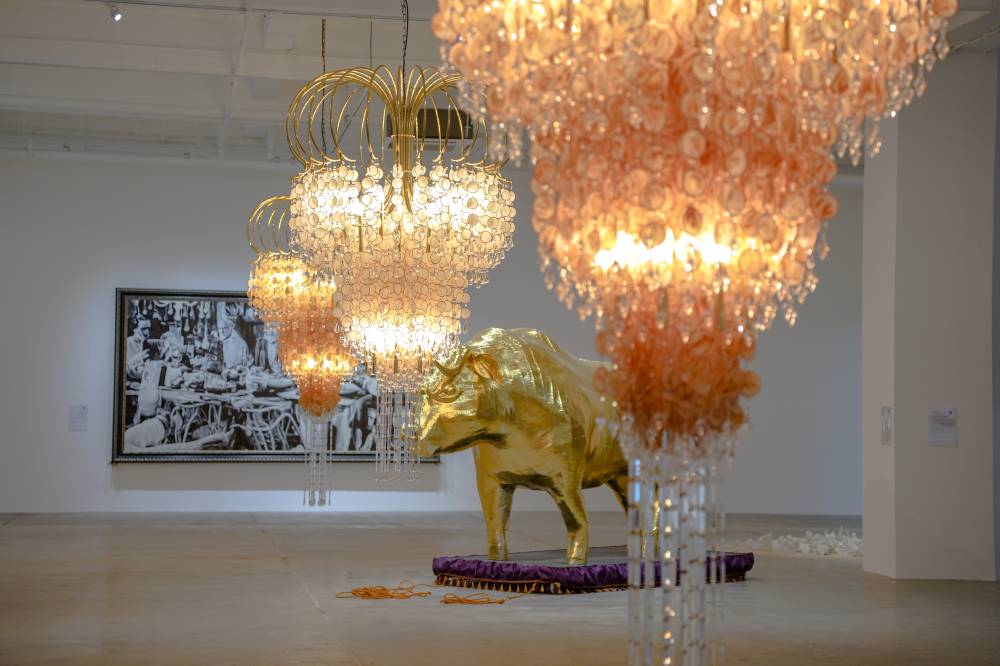
Yabang, the word in Tagalog, denotes pride, with all its performativity, quest for prestige, and ego. In Leslie de Chavez’s exhibition “Halik sa Lupa (A Kiss on the Ground),” his works embody that word perfectly, and a bit disturbingly, through three glittering fixtures suspended from the ceiling like crowns of a court gone wrong. The exhibition, curated by Joyce Toh and on view at Gajah Gallery Manila, also includes monumental sculpture, mixed-media installation, painting, and video works
The “Hiyas” series, meaning “gem” in Filipino, is the root of the word pahiyas, which means “to decorate” or “to adorn.” In that vein, De Chavez transforms the iconic chandeliers of the Cultural Center of the Philippines (CCP) as its point of departure and takes a very sharp turn, as the “gems” dripping from these fixtures are not glass, crystal, or even the delicate capiz shell that lines the walls of so many Filipino homes.
Instead, they are rice paper, pig intestines, and curtain fabric, stained with rust.
“I find it really interesting how you can alter this kind of form and suddenly put attention to it. How can you stretch it in such a way that it will also talk about someone else, other characters,” de Chavez says in an artist’s talk with Eileen Legaspi Ramirez.
The CCP chandeliers as laundering politics
The CCP was commissioned under Imelda Marcos, the first lady of former dictator Ferdinand Marcos and then-patroness of national culture. The CCP was, in the words of the exhibition text, “a modernist gem amid widespread poverty,” as a place that cultivated Ballet Philippines and the Philippine Philharmonic Orchestra—even as the Marcos regime bled the country dry.
Its chandeliers then became synonymous with “Imeldific” grandeur, with the neologism coined to describe her particular aestheticization of power in the conviction that beauty could launder politics.
De Chavez was raised in Lucban, Quezon province, and has watched how power displays itself through local festivals—from who decorates whose house for Pahiyas, to whose procession float shimmers brightest during Holy Week. “You can see the disparity,” he says in conversation. “This is how they display power… how they display wealth. And it is very much exhibited in how we express it through our rituals and our traditions.”
He continues, “I felt it was only proper that I also work with the idea of the chandelier, having that kind of history and origin that I have in Lucban, and that kind of association with the cultural sphere of the Philippines. I would like to believe I have the license to talk about these things.”
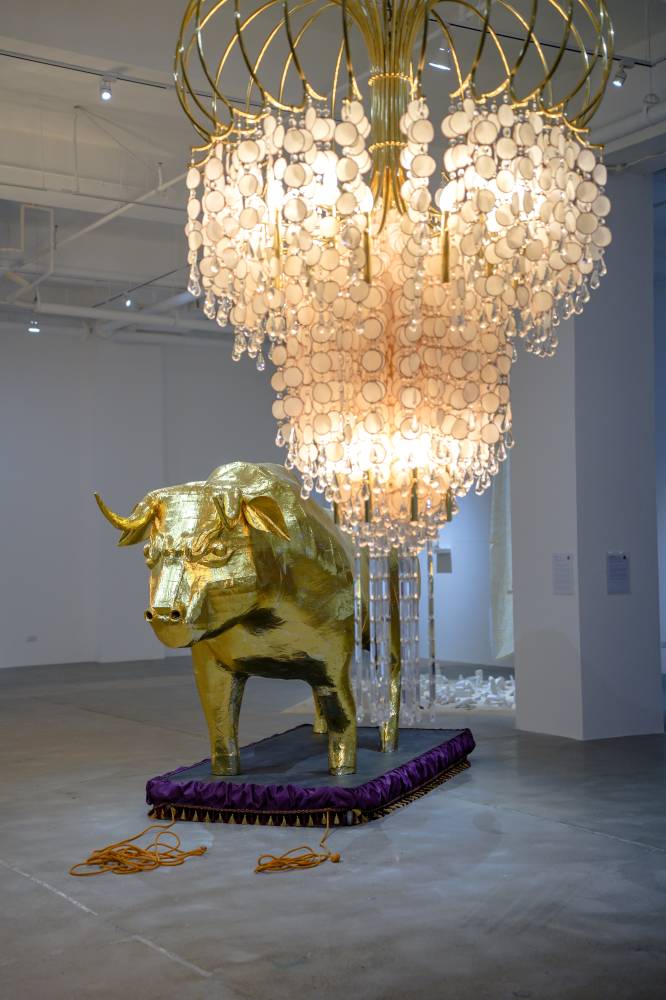
The rice chandelier
“Hiyas: Imelda” is built around rice paper formed to mimic capiz, the translucent shellfish panel found in Filipino homes. Except this capiz is different, as it is made of rice, and rice quickly crumbles and decays.
De Chavez links it directly to the kiping leaves of Pahiyas, the tissue-thin rice wafers hung from the facades of Lucban homes during the harvest festival. In “Hiyas: Imelda,” the exhibition notes write how “rice takes on the fragile form of luxury, destined to decay, its impermanence exposing the illusion of refinement.”
Imelda collected three thousand pairs of shoes, commissioned buildings while neighbors starved, and called her collecting habit “the good, the true, and the beautiful.” The chandelier answers her in her own language as shimmering, catching the light, but made of something that decays quickly, too.
The gut chandelier
If the rice chandelier is fragile, “Hiyas: Gloria” unsettles with its visceral aspects. The gems here are made of pig intestines that are desiccated, processed, and sealed in encaustic wax. De Chavez has used this material before in the past.
“The intestine is where nourishment is absorbed and waste processed,” the exhibition text notes, “a potent metaphor for the guts and for survival.” Within Philippine politics, the pig carries another connotation, making nods to “pork barrel,” the discretionary public funds that are often institutionalized for graft.
The pig intestine is also the casing for Lucban’s famous longganisa, the local sausage that de Chavez grew up seeing hung out to dry in the open air, attracting flies and curing in the heat. The chandelier holds both readings at once as disgusting and delicious, political and provincial.
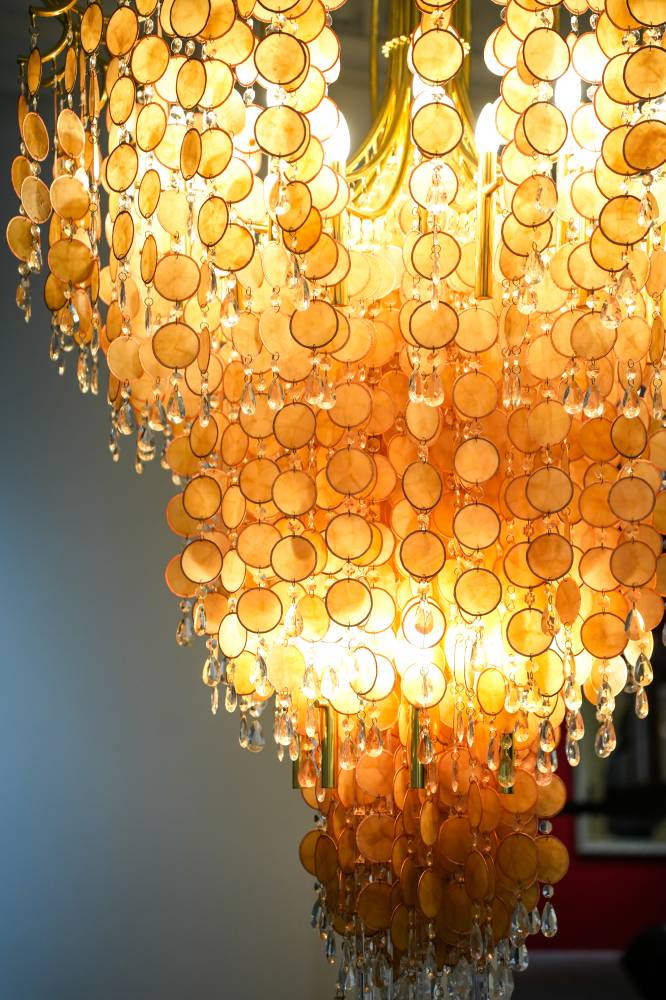
The rust chandelier
“Hiyas: Sara” shows gems cut from curtain fabric, specifically the cheap, patterned cloth found in ordinary Filipino homes, then stained with rust drawn from corroded nails. The rust lines are linear, suggestive of counting marks, like tally scratches on a prison wall, recording time and decay.

The work speaks to the figure of the trapo, which literally means “rag,” but is also an acronym for “traditional politician.” He points out how these politicians are marked by surface-level performances and a studied appearance of being reliable or relatable.
“Politicians who perform ordinariness, even intellectual modesty, to appear approachable and unthreatening,” the exhibition text observes. “For de Chavez, this is not sincerity but staging… an aesthetic strategy within the spectacle of power.”
Roots in politics and folk celebration
Having grown up with the tradition of hanging displays in the Pahiyas festival in Quezon, de Chavez doesn’t just see the chandelier as purely symbolic of elite power, but also of deep roots in folk celebration.
But now, it is also a form that reclaims and reframes that political power. Most Filipinos know the CCP chandeliers from television, school trips, or the gaudy cultural mythology of the Marcos era. De Chavez’s artistic choices take that unmistakable loaded form and repopulate it with matter from the margins of the political figures it now names, from rice to offal, and curtains.
“As an artist,” de Chavez says, “it is your duty to be selective of the most effective materials to use, to at least pique the interest of the people, so you can further the conversation you want to push for.”
Through his choice of materials, de Chavez goes beyond the initial grandeur of a chandelier’s shape, with materials that pique your interest to look closer, in a full accounting of what it costs to live in the Philippines, with all its harsh political realities.
“Halik sa Lupa (A Kiss on the Ground)” by Leslie de Chavez is currently on view at Gajah Gallery Manila, Unit 1B-1E, NBS Park, 125 Pioneer St, Barangay, Mandaluyong City, 1552 Metro Manila