





Cavite’s growth story: Accelerating not just emerging


Cavite is no longer just Metro Manila’s alternative address. It is fast becoming its most viable extension.
As developers recalibrate their strategies, the direction is clear: diversify, decentralize and secure a foothold in emerging growth corridors. In South Luzon, Cavite stands at the center of property gravity.
Once viewed as a peripheral support zone, Cavite has evolved into a multi-sector growth engine, moving from industrial anchor to a dynamic mix of residential, commercial and mixed-use developments.
Its place in the Cavite-Laguna-Batangas (Calaba) corridor, one of the country’s most active growth belts, positions the province not just as a spillover market but as a standalone investment destination.
Developers are responding with aggressive landbanking and masterplanned communities that capture urban expansion beyond Metro Manila.
Propelling price growth
Infrastructure connectivity continues to lift Cavite’s growth prospects.
Major infrastructure projects are redefining accessibility and are helping streamline travel time between key growth nodes.
The LRT-1 Cavite Extension alone is a game-changer, cutting travel time between Baclaran and Bacoor to just 25 minutes from over an hour. There’s also the Cavite-Laguna Expressway (Calax) and, on a grander scale, the Bataan-Cavite Interlink Bridge.
These projects collectively reposition Cavite as a high access, high growth investment hub. It should also make Cavite an attractive investment destination, enticing not just property developers but also manufacturers and logistics players which should help solidify the province as a dynamic investment destination.
End user, investor demand
Demand fundamentals remain robust.
Continuous remittance inflows—along with rising purchasing power and the growing preference for larger, open living spaces—anchor long-term residential absorption.
Lot-only offerings, in particular, are gaining traction. Investors are increasingly drawn to their capital appreciation potential, especially as Metro Manila’s land supply tightens and rental yields compress.
Cavite’s lot-only segment has delivered consistent price growth, reinforcing its appeal, both as an end-use and investment play.
High absorption, stable growth
Cavite’s residential market continues to post healthy fundamentals.
House-and-lot (H&L) developments, particularly within the economic segment, maintain strong take-up rates nearing full absorption. As of end 2025, average take-up of H&L projects in Cavite reached 95 percent with an average price of P3.4 million per unit.
From 2016 to 2025, Colliers recorded an average annual price increase of 2 percent for H&L units in Cavite. Key
cities and municipalities are becoming hubs for massive developments, backed by their accessibility, affordability, and proximity to employment hubs, retail centers and institutional facilities.
For the premium segment, lot-only developments have similarly posted robust uptake, reflecting a deep pool of buyers seeking long-term value and diversifying property investment mixes.
As of end 2025, overall take-up of lot-only projects in Cavite reached 94 percent, priced at an average of P20,000 per sqm a unit. Residential lots in Cavite also posted a five percent average price growth annually from 2016 to 2025.
With limited land opportunities in Metro Manila, Cavite effectively captures spillover demand from affluent buyers while offering competitive pricing and larger lot sizes.

The new competitive edge
As more developers gravitate towards South Luzon, differentiation has become critical. The next wave of growth will not be driven merely by location but by experience.
Integrated communities anchored on “live-work-play” concepts are no longer optional—they are expected.
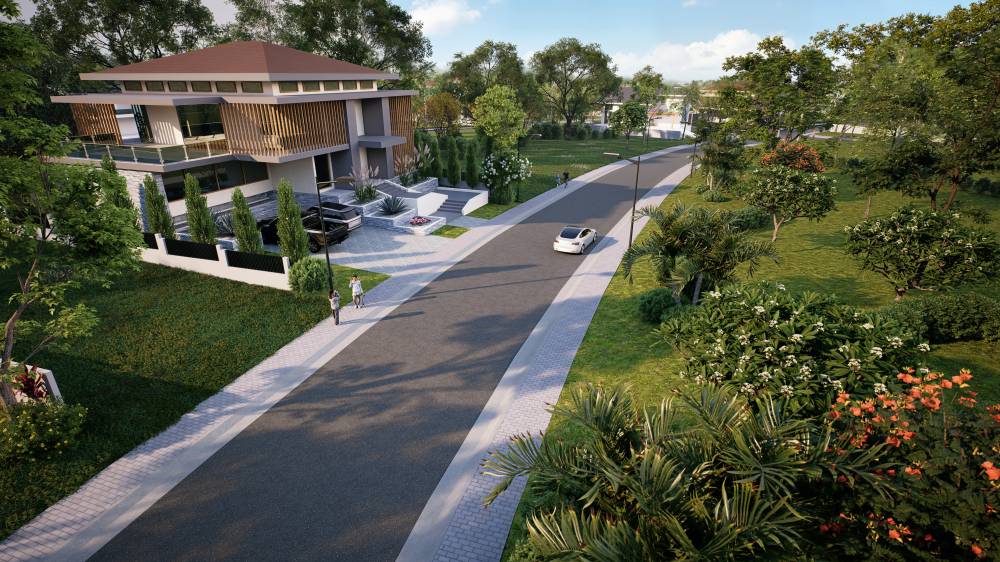
Developers are stepping up by embedding lifestyle and wellness into their projects: expansive green spaces, sports hubs, bike lanes, jogging trails, and recreational amenities.
These features not only enhance desirability but align with the evolving preferences of a more discerning market.
Complementing the growth story
Cavite’s transformation is incomplete without its commercial evolution.
As economic activity intensifies and population density rises, the need for schools, hospitals, retail centers, and business hubs becomes more pronounced. This creates fertile ground for commercial lot development.
Developers are beginning to capitalize on this, launching projects that cater to expanding business operations and institutional demand. With improving infrastructure, rising incomes, and sustained regional growth, Cavite’s commercial segment is poised for meaningful expansion.
What’s next for Cavite
Catching up is no longer in the playbook of developers with massive footprint in Cavite.
In fact, the locality is pulling ahead, providing first-mover advantage for developers with massive office, residential, retail, leisure, and industrial investments. Supported by massive infrastructure investments and defined by strategic diversification from property firms and buyers, the province is fast becoming a major property growth corridor.
For developers and investors, a key recommendation is to follow the government’s infrastructure push, proactively capture the demand, and scale with purpose. In South Luzon, Cavite is definitely at the center of property gravity.