






Making room for water


The rains are coming again. They always do. Every year, as the season turns, we brace ourselves for the same familiar story of swollen rivers, submerged streets, and families wading through chest-deep water to save what they can.
And every year, we answer the same way—with dikes, pumps, and concrete, spending hundreds of millions, sometimes billions of pesos, trying to push the water away.
Yet the floods return, often worse than before. Perhaps, it is time to ask whether we have been fighting the wrong battle all along.
Nature-built infrastructure
At WTA Labs, we have been studying a different idea—one that begins not with how to keep water out, but with where water wants to go.
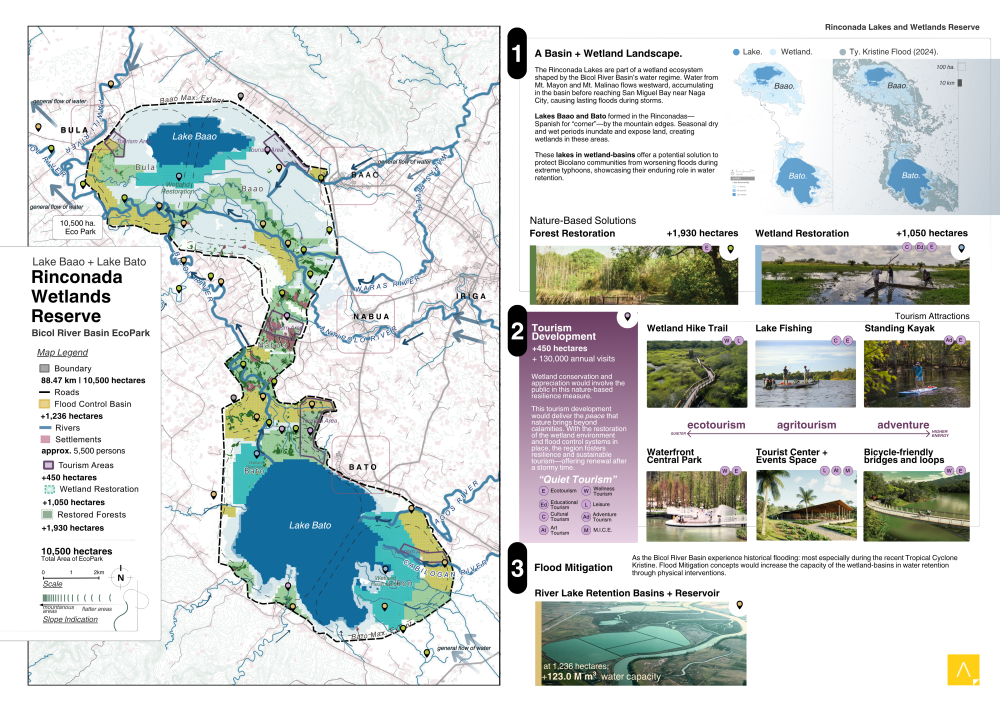
Our research has taken us to the Bicol River Basin, to a quiet corner of Camarines Sur where two lakes, Bato and Baao, rest at the foot of the highlands. The Spanish called this place Rinconada, “the corner.”
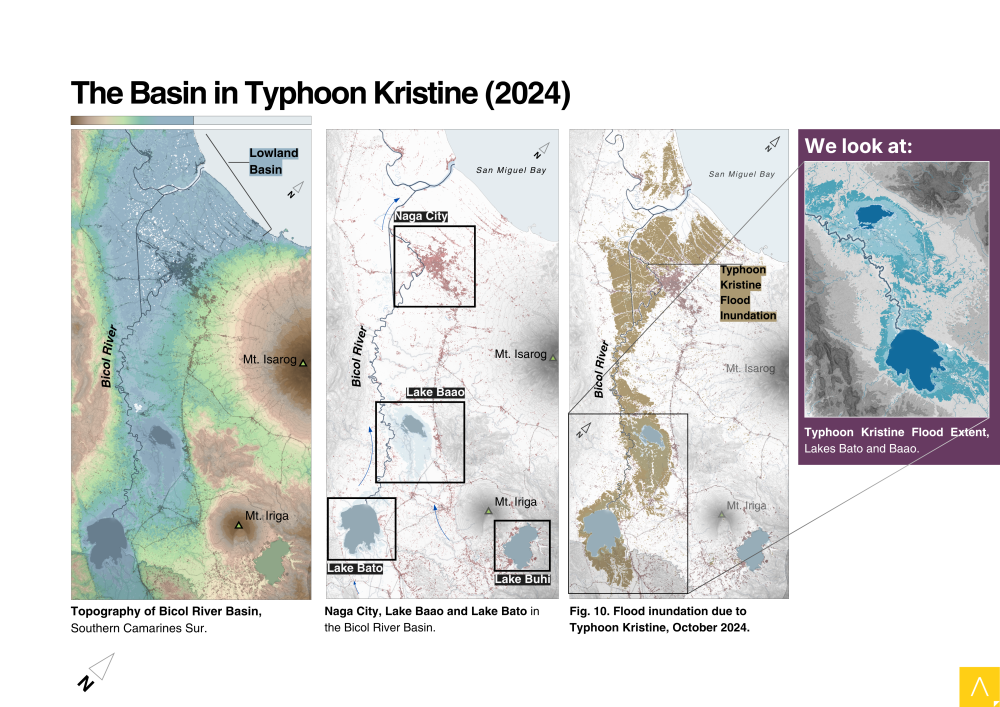
It is here, in this natural basin, that water from Mayon, Malinao, and Isarog gathers before making its long journey north past Naga City and out to San Miguel Bay. When Typhoon Kristine struck in 2024, it was this corner that bore the flood. And in bearing it, the corner revealed its purpose.
These lakes are not obstacles. They are infrastructure that nature built for us. For generations, they have served as catch basins, slowing and holding and releasing floodwater that would otherwise rage downstream into our cities.
The proposal we have been developing, the Rinconada Wetlands Reserve, simply asks us to strengthen what already works.
Through a network of retention basins, strategic levees, and restored wetlands and forests, the lakes could hold an additional 123 million cubic meters of floodwater. That is not a metaphor for resilience. That is resilience, measured in volume.
Giving room for water
But here is what makes the idea worth more than its hydrology. When you give water room, you give life room too.
The same restored wetlands that temper a flood become a sanctuary for the Sinarapan, the smallest commercially harvested fish in the world, found nowhere on Earth but here.
The same basins that shield Naga City become rice paddies in the dry season and fishing grounds in the wet.
The fisherfolk whose crowded fish pens once left them vulnerable could become the stewards of a managed sanctuary. The families along the riverbanks could welcome visitors into elevated homestays.
A flood-control project becomes, almost as an afterthought, a wetland park, a research station, a destination—perhaps 130,000 visitors a year, coming to kayak, to fish, to walk the trails and watch the birds.
Solving a flooding problem
This is not wishful thinking. In Hokkaido, the Chitose River was once a source of devastating floods.
The Japanese built a chain of flood-control basins to tame it, and those same basins are now a protected wildlife reserve, home to the endangered red-crowned crane. They solved a flooding problem and gained a national treasure in the process. They worked with the water, and the water rewarded them.

We are a nation shaped by water. We will never engineer our way out of the rain. But we can decide whether the rain destroys us or sustains us.
The difference is not money. We already spend enormous sums fighting floods that keep coming back. The difference is imagination and the willingness to see a flooded lowland not as a problem to be drained but as an asset to be cultivated.
A first step
This research is a first step that serves as an invitation to the people who can act on it: the leaders of Naga and the towns of the Rinconada, the planners of Camarines Sur, the agencies who hold the budgets and the maps.
The Rinconada Wetlands Reserve is, on its surface, an almost embarrassingly simple idea: let the water rest where it has always rested, and build a thriving region around it.
But the simplest solutions are often the ones we overlook, precisely because they ask us to change not our tools but our thinking. The full study is available at www.wtalabs.ph, and we welcome anyone who wishes to help carry it forward, whether communities, scientists, agencies, or fellow dreamers.
So what if, instead of spending another generation fighting the water, we finally made room for it? What if the very thing we dread each rainy season could become the foundation of our resilience, our livelihoods, and our shared future?
The corner is already there, holding its breath, waiting. We need only the wisdom to let it do its work.
Design exploration requires the input of everyone in our community. We invite everyone to come join our explorations on the human environment. Join us on Instagram @wtadesignstudio and @entrari