
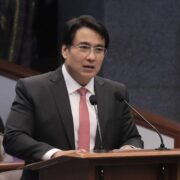

Loren, son face Ombudsman probe; ‘baseless,’ she says


Sen. Loren Legarda, her son, Batangas Rep. Leandro Leviste, and former Energy Secretary Alfonso Cusi will undergo a preliminary investigation for alleged plunder and graft in connection with solar “ghost electricity” projects of the young lawmaker worth over P10 billion, Ombudsman Jesus Crispin Remulla announced on Friday.
Legarda said in a statement that they haven’t received any word from the Office of the Ombudsman regarding the opening of an investigation into their alleged wrongdoing.
“But I can categorically state that the reported accusations are utterly false and baseless. No public funds were involved. We are prepared to bring out the truth,” Legarda said.
“This baseless allegation is a smear on my person that is totally undeserved,” she added.
The preliminary investigation, which could lead to formal charges before the Sandiganbayan, follows a fact-finding probe, which began in January this year on orders by Remulla last November.
Ombudsman investigators said Legarda, Leviste and Cusi allegedly “conspired to secure exclusive government rights over the country’s solar energy resources through legislative and regulatory actions.”
“We’ve been hitting ghost projects, but this one is ghost electricity,” Remulla said during a press conference. “They promised to produce electricity, they promised … to produce it using solar but they did not do it.”
Loren: Be ‘discerning’
In her statement, Legarda said that since her “public life” began in 1998, she had “always upheld my integrity, which I value dearly.”
She urged the public to be “discerning,” citing the timing and nature of the allegations.
“We remain confident that once the facts are laid bare, we will be vindicated and our names cleared,” Legarda said.
Her son, who founded the Solar Philippines Power Project Holdings Inc. (SPPPHI) in 2013 when he was just 20 years old, won more than 30 service contracts with the government.
Remulla said the terminated contracts resulted in more than P10.44 billion in unpaid financial obligations to the government.
“The P10 billion is just in the contract, but the amount lost to us Filipinos is in the hundreds of billions,” Remulla said.
The Office of the Ombudsman opened the probe on Leviste over the sale of one of his solar energy companies. Remulla said that legal questions needed to be raised after Leviste sold his Solar Philippines New Energy Corp. (SPNEC) in 2023 to tycoon Manny V. Pangilinan, despite the transfer of the controlling interest not having been approved by Congress.
Leviste and Cusi had no immediate comment on Remulla’s announcement.
Tied to Cabral files
Responding to the fact-finding probe earlier this year, Leviste said the move was an attempt to silence him over his plan to expose the so-called “Cabral Files,” which allegedly detail massive corruption surrounding flood control projects.
After Remulla’s press conference, the Office of the Ombudsman released a statement, saying that “the number of service contracts obtained by Leviste created a virtual monopoly of solar energy projects.”
“Numerous exclusive solar energy service contracts were awarded to corporations within the alleged network, but many of the projects were never developed as promised,” the statement said. “All indicators point to the fact that they had no intention to fulfill contracts that they had garnered.”
Remulla said Leviste could not have obtained the exclusive contracts without the help of his mother, the chair of the powerful Senate finance committee, “who used her position so her son could get franchises.”
He said there was a violation of the conflict of interest provision in the antigraft and corruption law.
On July 31, 2019, then President Rodrigo Duterte signed Republic Act No. 11357 granting the franchise for the operation of Solar Para sa Bayan Corporation (SPBC), a renewable energy distribution company owned by Leviste, who was then only 25 years old.
The “nonexclusive franchise” was for the construction, installation, establishment, operation and maintenance of solar-powered facilities to provide renewable energy to areas without electricity, or those “underserved,” nationwide.
Call for review
Before the measure was signed into law, several business groups asked Duterte to review the SPBC franchise, citing its possible impact on small, mini, and microgrids in the country.
The groups included the American Chamber of Commerce of the Philippines, the Financial Executives Institute of the Philippines, the Makati Business Club, the Management Association of the Philippines, the Semiconductor and Electronics Industries in the Philippines, Inc., and the Women’s Business Council Philippines.
They said the franchise “will create an undue competitive edge” in favor of SPBC to the disadvantage of other renewable energy companies.
In June 2019, anticorruption watchdog Anti-Trapo Movement (ATM) alleged that Legarda violated the Constitution with the approval of the bill granting a 25-year franchise to her son’s company.
Ethics complaint
In December 2018, the group filed an ethics complaint with the Senate ethics committee then headed by Sen. Manny Pacquiao.
It also filed a complaint with the Presidential Anti-Corruption Commission, which referred it to the Office of the Ombudsman.

ATM founding chair Leon Peralta said that Legarda was not allowed to have a “direct or indirect interest in a franchise granted by the government” under the Constitution as the mother of the franchisee.
Legarda said that when the Senate and the House of Representatives ratified the bill on June 3, 2019, she abstained from voting “out of delicadeza.”
The ATM, however, alleged that Legarda’s Senate staff actively followed up on the progress of her son’s franchise request in the House Committee on Legislative Franchises.
In February 2026, the Energy Regulatory Commission said SPBC may face up to P150 million in new penalties as regulators began a probe into its alleged illegal and excessive power charges.
The Department of Energy (DOE) also imposed a penalty of P24 billion against SPPPHI, a corporation that is 100-percent owned by Leviste, for failing to deliver more than 11,000 megawatts of renewable energy capacity.
DOE action
In May 2026, the DOE filed a complaint against Leviste and several directors of SPBC, alleging that the group had failed to fulfill its obligations under its legislative franchise.
The DOE noted that SPBC did not even have a single project or operation when it was granted its legislative franchise in 2019.
“Worse, during these years, SPBC continuously established and provided renewable energy for profit through several groups of companies under the umbrella of SPPPHI,” it said.
In June 2026, the DOE filed a civil complaint against Leviste to compel him to pay P1.18 billion for his alleged failure to deliver a 120-megawatt solar project.
The agency filed a civil complaint against the lawmaker before the Regional Trial Court of Taguig City, to collect a performance bond.
This was after his company, Solar Philippines Commercial Rooftop Projects Inc., along with related corporate entities, allegedly failed to develop the General Santos solar farm that was supposed to boost the power supply of the Mindanao grid. —WITH REPORTS FROM ISABELLE PECHAY AND INQUIRER RESEARCH
******
Get real-time news updates: inqnews.net/inqviber