








Metro Manila offices stay strong in 2026


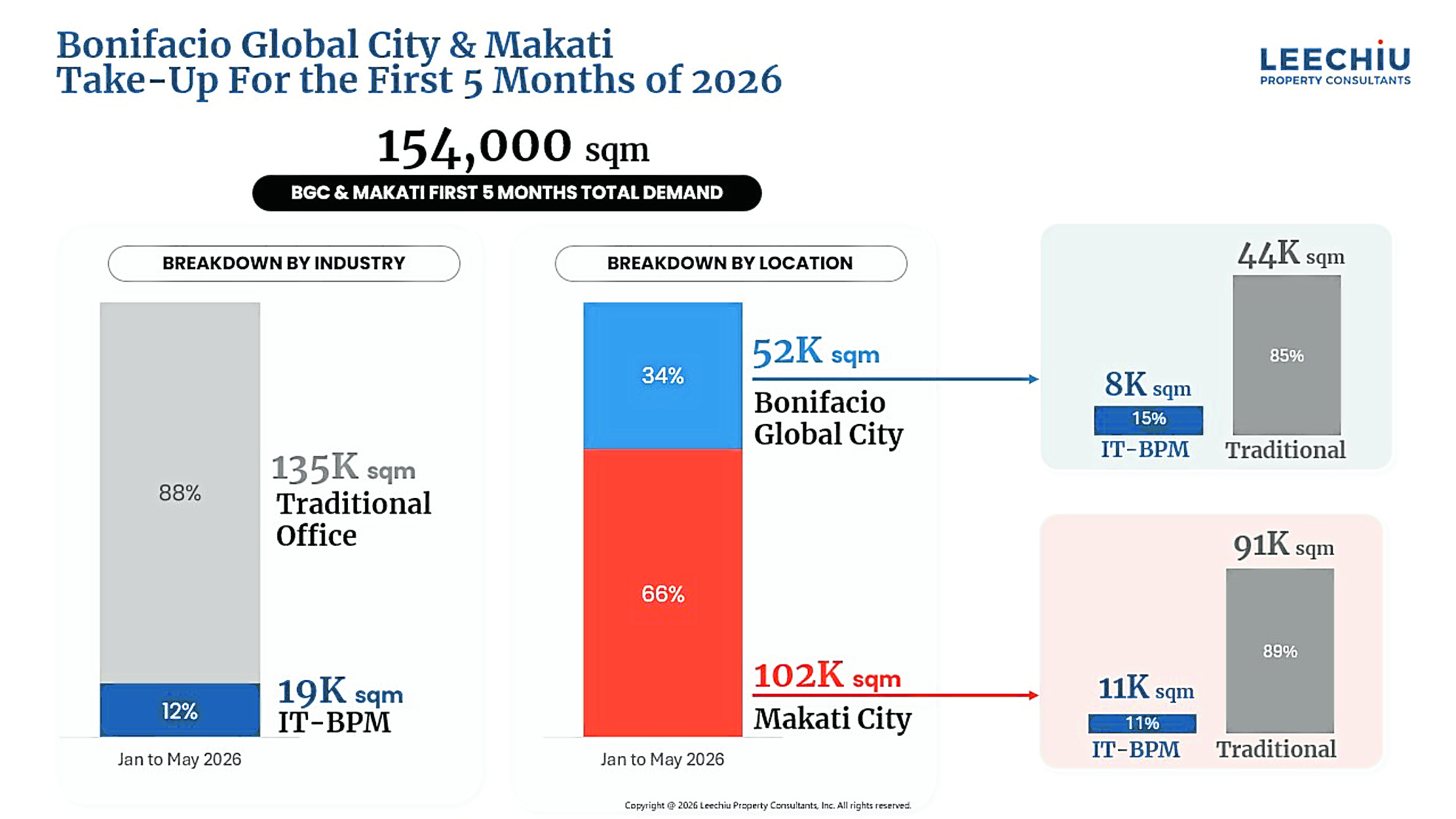
Metro Manila’s office market held its ground in the first five months of 2026. Despite a steady backdrop of geopolitical and domestic uncertainty, companies leased 154,000 sqm of office space across Makati and Bonifacio Global City (BGC), a healthy figure that pushes back on the notion that offices are losing relevance.
The more revealing story, however, lies in the gap between the deals already signed and the demand still building.
Strong value, premier address
Makati led the leasing activity, capturing 66 percent of total take-up, or 102,000 sqm.
The pull toward the country’s traditional central business district comes down largely to price. Rents in Makati have become more achievable, offering strong value for a premier address.
That value has drawn a particular kind of occupier. Government offices, corporate headquarters, and managed facilities accounted for bulk of the leasing. These are tenants who prize stability and location, and Makati now offers both at a more competitive cost than it did a year ago.
This dynamic is also reshaping the landlord and tenant relationship in the city. With vacancy in Makati expected to remain elevated, landlords are likely to keep lease rates competitive and terms flexible.
For occupiers, that translates into room to choose and genuine space to negotiate, an advantage that does not come around in every cycle.
Yet the deals that have closed tell only half the story.
Demand bound for BGC
Live demand, the requirements of tenants still actively searching for space, points in a different direction. That pipeline stands at 137,000 sqm, and its composition flips the narrative: 76 percent of it comes from IT and business process management (IT-BPM) firms, and 82 percent of that demand is bound for BGC.
Far from retreating, the outsourcing and technology sector remains the single largest source of future office requirements.
This is the clearest evidence that talk of a fading BPO industry is overstated. Despite the spread of hybrid work arrangements and a more challenging economic environment, IT-BPM companies continue to plan for growth, and they continue to favor BGC.
For landlords and investors, that forward-looking demand is a meaningful signal of where the next wave of leasing is likely to settle.
Strongest submarket
BGC, for its part, remains the strongest submarket in Metro Manila.

Occupancy there sits at around 91 percent, the highest among the major districts, while other areas continue to feel the weight of oversupply. With limited available space and resilient demand pressing against it, the leverage in BGC is shifting toward landlords, and rental rates are expected to firm up.
Companies set on a BGC address would do well to act sooner than later, as the best options tend to move quickly.
Two lanes
Taken together, the two measures describe a market that is not slowing but separating into two distinct lanes.
Makati is winning the deals being signed today, carried by value rents and traditional occupiers. BGC is winning the demand of tomorrow, driven by a resilient BPO sector.
For any company weighing an office move in 2026, the question is no longer whether to act, but which of these two markets fits the strategy, and how quickly the window in each is likely to close.
The author is co-founder and director for Commercial Leasing at Leechiu Property Consultants Inc.


