




Old bones, smart money: Why Makati’s aging office buildings should also be saved—not scrapped


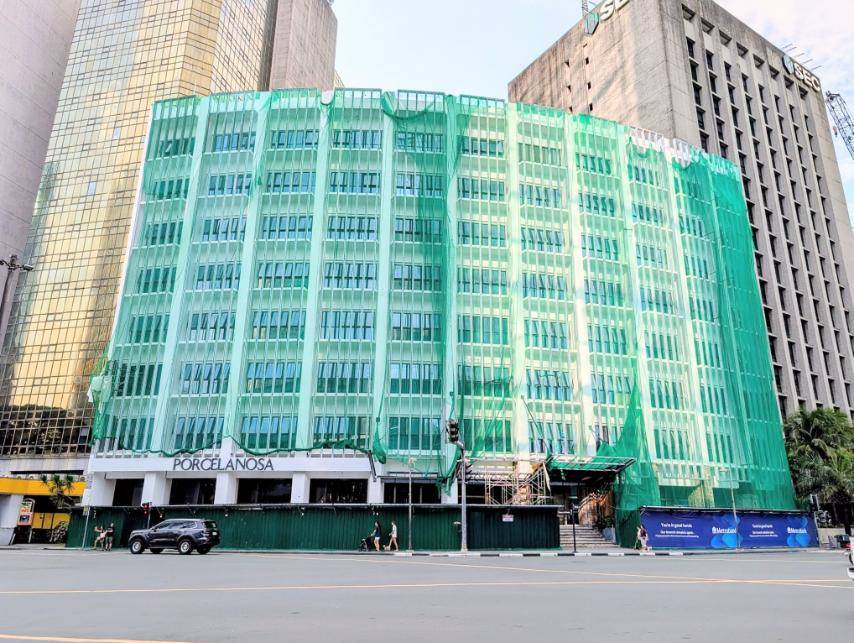
On a corner where Paseo de Roxas meets Makati Avenue, scaffolding wraps the exterior of Peninsula Court, a low-rise office building that has quietly occupied one of the central business district’s (CBD) most prominent intersections since 1988.
The works underway are not demolition—they are transformation. The building’s owners chose to retrofit and modernize rather than tear down and start over. In today’s market, that is looking like the smarter bet.
JLL’s landmark research series “Opportunity through Obsolescence” identified a quiet crisis unfolding across the world’s major office markets—and embedded within it, a significant opportunity.
Of the 776 million sqm of existing office space surveyed across 66 global markets, roughly half are likely to require substantial capital investment to remain viable in the near term. The price tag for inaction could run between $933 billion and $1.2 trillion globally.
The alternative is proactive retrofitting: turning the risk of obsolescence into a source of value creation. That global argument has a local application in CBDs like Makati.
What Asia’s CBDs are telling us
The same dynamics playing out in Hong Kong and Singapore are arriving in Makati, just a few years behind.
JLL’s 2025 report, “Smart Upgrades for Big Impact”, found that nearly 44 percent of Hong Kong’s Grade A office space is now over 30 years old, with capital and rental values for poorly maintained buildings potentially declining by as much as 20 percent if left unaddressed.
For buildings that invested in deep retrofits, the story reversed: a 9-percentage-point lower average vacancy rate, a 4.6 percent rental premium, and meaningful gains in net operating income over a 10-year period.
Singapore offers a completed proof of concept. Cross Street Exchange, now known as 18 Cross, was transformed into a Grade A office tower and sustainable commercial hub.
The conclusion JLL drew is direct: Refurbishment is increasingly viewed as a proactive value creation tool.
Makati is tightening
Makati CBD’s office vacancy rate at present is at 18.5 percent. Expected new office completions here are mostly from local banks building their owner-occupied headquarters. More than half of the district’s office buildings meanwhile are already over 30 years old.
Based on my observation, Makati CBD is not oversupplied—it is under-upgraded. The vacancy numbers look manageable on paper, but strip out the buildings that are move-in ready to modern standards and the available supply becomes tight in CBD locations desired by the top global tenants.
The tenant has also fundamentally changed. JLL’s Global Real Estate Outlook identified “experience obsolescence” as a defining challenge—the growing risk that structurally sound buildings lose tenants because they can no longer deliver the workplace experience occupiers now expect.
New construction is not the answer right now
Philippine Statistics Authority data showed average construction costs in early 2026 running 35 percent higher year-on-year. A developer who begins permitting today on a new Makati CBD building is unlikely to see rental income before 2030 or 2031.

For a standing asset at a premier address, the return calculus simply does not support demolition for now.
Retrofit can be executed in phases, maintains income continuity, and preserves the one thing no balance sheet can manufacture: location.
The window
The scaffolding on Peninsula Court’s facade is a statement of intent, arriving at precisely the right moment in the market cycle.
The window for tenants to secure space during an active upgrade—at a competitive rate, in a premium location—is not permanently open.
The occupiers who move now will have locked in the address and fairly the terms. While technology to support our buildings keep changing, one thing remains for sure—location is st-ill an integral part of selecting your next office space!
The author is the country head of JLL Philippines


