









The white button-down is more than a basic


There’s a word that gets thrown around a little too easily when it comes to the white button-down, and that’s “basic.” As if being reliable makes something less interesting, as if a piece that works across settings, across seasons, across decades somehow matters less than whatever trend happens to be circulating at the moment.
But the more you sit with it, the more that framing starts to feel off because if anything, that consistency is the point—and it’s worth asking why this one shirt has managed to outlast entire aesthetics that come and go with far more noise.
The white button-down doesn’t try too hard, and maybe that’s exactly why it works. It doesn’t push for attention, and it doesn’t fade into the background either. It just holds everything together in a way that feels almost incidental, as though it isn’t doing much at all, when in reality it’s doing quite a lot. In a wardrobe full of statements, it’s the piece that gives everything else space, the one that allows other elements to land properly without competing with them.
Call it a basic if you want, but it’s very likely the hardest-working thing in your closet.
The range is the point
What makes the white button-down compelling isn’t just that it’s versatile, because versatility on its own isn’t rare. What sets it apart is how completely it can shift, not just from one setting to another, but from one mood to the next—depending on how it’s worn, how it’s styled, and even how you carry yourself in it.
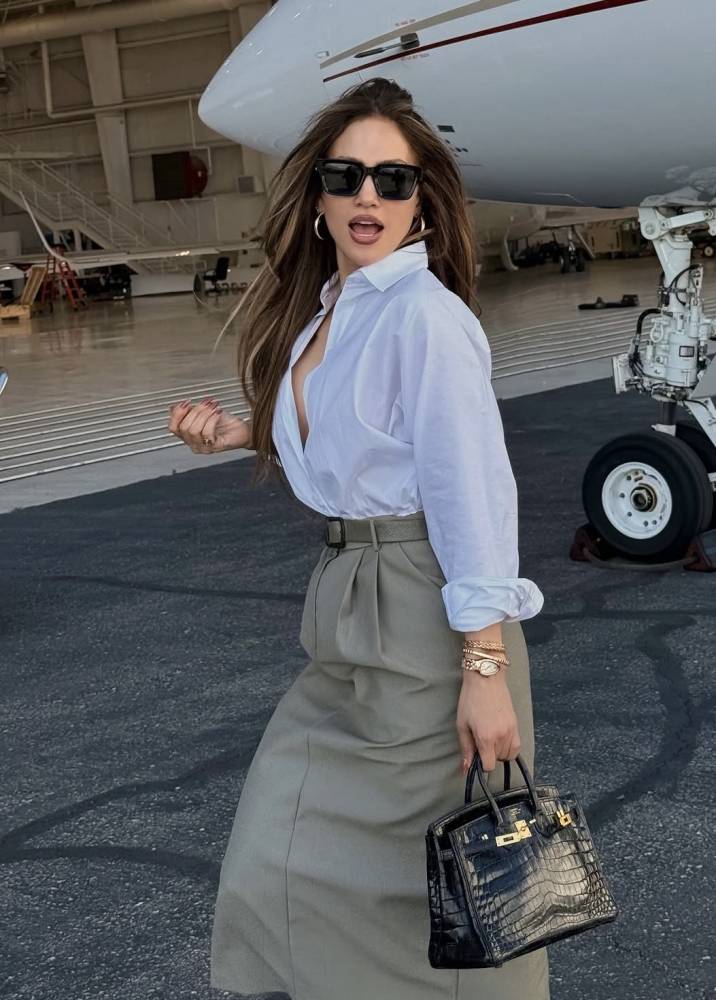
Button it all the way up, and it reads sharp, almost formal, with a kind of clean precision that feels deliberate without being rigid. Leave a few buttons undone, and it softens almost immediately, taking on a more relaxed feel. Worn oversized and slightly undone, it leans into something casual, almost borrowed, and while thrown over a tank or swimwear, it becomes transitional in the easiest way, like it belongs wherever you happen to be.
It doesn’t really have a fixed identity, which is what makes it so useful. It takes on yours.
Tucked into tailored trousers, it pulls everything into place with very little effort, while knotted at the waist over denim, it shifts into something more styled—a little more directional, without feeling overworked. Worn on its own, oversized enough to pass as a dress, it becomes minimal in a way that still feels intentional.
The range isn’t overwhelming, and it doesn’t feel like a list of options you have to work through. It all feels natural, almost instinctive, which is why it works as well as it does.
Why it still matters
Fashion moves quickly now, faster than it ever has, with trends cycling in and out before most people have had the chance to decide how they feel about them. Entire aesthetics rise, saturate, and disappear within a single season, replaced almost immediately by something new.
And through all of that, the white button-down remains largely unchanged. It doesn’t rely on trends to justify itself, and it doesn’t need to be reintroduced or reinterpreted every few months to stay relevant. It simply works in a way that feels increasingly rare.
It’s often the piece you reach for when everything else starts to feel like too much, when an outfit needs to be reset or clarified rather than added to. It brings a kind of visual calm, making things feel more considered without requiring extra effort.
At the same time, it allows everything around it to come through more clearly. Prints feel sharper, textures feel more intentional, and accessories feel more defined. There’s something about having that clean, grounding element that makes the rest of an outfit make more sense.
The blank canvas that isn’t blank
It’s often described as a blank canvas, but that description only goes so far, because a canvas is passive, and the white button-down isn’t. It responds to what you pair it with, to how it’s cut, to the fabric it’s made from, and that responsiveness is what gives it range.
Fabric alone can completely shift its tone. A crisp cotton poplin shirt feels structured and precise, almost architectural in how it holds its shape, while linen softens everything, introducing a slightly lived-in quality that feels more relaxed and less deliberate. Silk, on the other hand, moves differently, catching light in a way that feels more fluid.
The shape might stay the same, but the feeling changes entirely.
Fit does something similar. A tailored shirt, with clean lines and a defined structure, reads differently from something oversized, which feels more effortless, more undone, or from a boxier cut that leans more modern. And none of these is interchangeable, even if they appear similar at first glance.

And that’s really where the interest lies, not in the shirt itself, but in what you choose to do with it. Minimal doesn’t mean neutral, and a white button-down, when worn with intention, still carries a point of view. It’s just expressed more quietly.
Part of why people keep coming back to the white button-down has less to do with habit and more to do with trust. Once you know it works, you stop questioning it, and that removes a certain kind of friction from getting dressed.
A white button-down moves easily across settings without needing to be adjusted, and it doesn’t date in the way more specific pieces do. You put it on, and it makes sense—which is sometimes all you really want from a piece of clothing. It’s called a basic, but it’s the piece doing the most work.
Button-up vs. button-down
They’re often used interchangeably, but they’re not the same.
A button-up is any shirt that fastens with buttons down the front. It’s the broad category, covering everything from dress shirts to more casual styles.
All button-downs are button-ups, but not all button-ups are button-downs.
A button-down refers specifically to the collar. It’s a button-up with small buttons that fasten the collar points to the shirt.
Originally designed for polo players to keep collars in place, the button-down has a slightly more relaxed, sport-influenced feel.