



The logic chain: A strategic stress test for value creation


Many treat strategy as creative work, a series of “sparks” or lucky breaks.
But strategy is not an art form. It is a discipline of structural integrity. If the structure does not hold, even the most brilliant idea will fail in the marketplace.
In June 2010, I introduced the 11 building blocks of the Business Model Map to help leaders design and diagnose their business.
Over the years, I observed a consistent, fatal pattern: teams would complete all 11 blocks with great enthusiasm but skip one critical step. They never checked if the core idea itself actually made sense. They were building in exquisite detail what was fundamentally flawed in logic.
Defining the reasoning stack: Pila
This is where the logic chain comes in. It is not a replacement for the 11 building blocks. It is a nonnegotiable precondition.
To understand its power, we must look at where it sits within the Pila (Problem, Insight, Logic, Assumptions) reasoning stack.
The logic chain is the L in Pila. While the I (Insight) identifies a unique friction point, the L (Logic) is the stress test that determines if that insight can be converted into a sustainable business model.
Furthermore, Pila is a core component of transparency, the element of the Trust Economy Flywheel that links internal alignment to external confidence. When logic is weak, transparency breaks. When transparency breaks, trust becomes impossible to sustain.
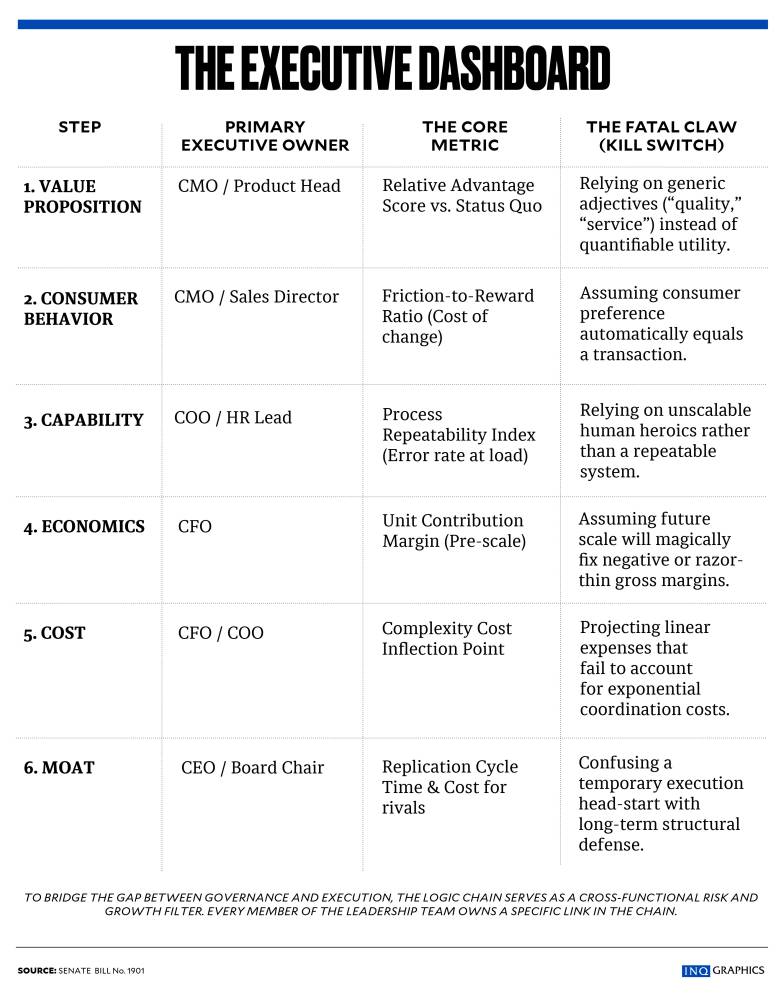
The five-step logic chain
The logic chain allows boards and management to enforce rigor without micromanagement. If a strategy does not pass these five links, it has no business being scaled.
1. Value proposition (marketing)
Does this solve a real problem better than any available alternative?
For a value proposition to be valid, it must be relevant, unique and believable. Most organizations settle for generic descriptions like “quality” or “service.”
If your value is not distinct, the market will default to the only metric it has left: price.
2. Consumer behavior (sales and marketing)
Strategy often fails because it assumes that people will change their habits simply because a new product exists. You must define the required shift. Are you looking at trial, switching or a total habit change?
We use the Bida (barriers, irritants, disappointments and annoyances) framework to identify the psychological and physical friction points. Crucially, these frictions are often cumulative and leaders must understand the hierarchy of pain for the consumer.
- Barriers: What stops them from starting? (e.g., a school’s high down payment).
- Irritants: What creates friction during the process? (e.g., long, slow registration lines).
- Disappointments: Where do we fail their expectations? (e.g., finding that the course description was outdated).
- Annoyances: What is the “last straw” that finally makes them look elsewhere? (e.g., being repeatedly bumped off from several subjects during enrollment).
3. Economic drivers (finance)
Where does the money come from and why is it repeatable?
A logic chain must validate pricing logic and margins. If profitability depends solely on volume without a clear structure, the model is fragile.
At some point, the numbers always expose the weakness of the logic.

4. Capability and cost (operations and HR)
Can the organization actually deliver the promise? This requires a cold-eyed audit of systems, skills and the “cost to serve.” Many strategies look spectacular on a slide deck but collapse because the operational cost exceeds the value created.
5. Moat (strategy)
A moat is not a story you tell after you’ve succeeded. It is a condition you design before you spend a single peso on scaling.
Why won’t competitors simply copy you? Without a moat, growth is merely an invitation for competition to erode your margins.
Case study: Reconfiguring the education sector
I recently served as the closing keynote speaker at the Mindanao Marketing Summit and conducted a Marketing Educators Masterclass earlier that day. We applied the logic chain to schools.
The gaps were immediate and instructive.
- Value proposition: Most schools claim “quality education”. But does that mean industry readiness, values-based leadership or employment outcomes? Without clarity, there is no differentiation.
- Consumer behavior: Many schools face a massive dropout rate between the first and second semesters. This is a Bida issue. What irritants or disappointments are students facing in those first few months?
- Economic drivers: Schools often rely on a mix of tuition and donations but lack a clear long-term model for sustainability. If the economics aren’t transparent, growth creates pressure rather than stability.
- Capability and cost: I challenged the educators to ask: Why operate five days a week? Moving to a four-day week could drastically reduce utility and transportation costs for students—a strategic reconfiguration. The standard answer of “because everyone else does” is not a strategy; it is imitation.
- Moat: This is where schools struggled most. Is the moat the curriculum, the brand or the industry partnerships? If the moat is unclear, the position of the institution is inherently weak.
The strategic mandate
The real risk in business is not a bad idea. It is the act of scaling an idea that was never sound to begin with.
The logic chain forces marketing, finance and operations to align early.
Clarity is rarely the problem; discipline is. When leaders insist on strong logic at the start of the Pila stack, they do more than improve decisions. They strengthen transparency; they build trust; and they create organizations that work in practice, not just in theory.
Josiah Go is a business thought leader, bestselling author of 20 books in marketing and entrepreneurship and the chair of Mansmith and Fielders Inc. He is the cocreator (with Chiqui Escareal-Go) of the Pila Framework and the Trust Economy Flywheel.