









Ashfall from Kanlaon blast blankets Negros

BACOLOD CITY—A moderate explosive eruption at Kanlaon Volcano on Thursday night, followed by renewed ash emissions on Friday morning, has blanketed over 100 barangays across 18 towns and cities in Negros Occidental with ash and sulfuric smell, local authorities said.
The municipalities affected include La Castellana, San Enrique, Murcia, Hinigaran, Moises Padilla, Binalbagan, Isabela, Pontevedra, Ilog, Hinoba-an, Candoni, and Cauayan, while the cities impacted are La Carlota, San Carlos, Bago, Himamaylan, Kabankalan and Sipalay.
In response, 23 families—totaling 81 people—have evacuated from La Carlota City and La Castellana. Twelve towns and cities also suspended classes on Friday as a precautionary measure.
The eruption began at 7:04 p.m. on Thursday, sending fire and ash skyward for roughly two minutes, according to the Philippine Institute of Volcanology and Seismology (Phivolcs).
According to the agency, a dark gray plume rose 2,500 meters above the vent and drifted southwest, producing volcanic lightning at least three times.
Incandescent ballistic fragments were ejected up to 1.5 kilometers from the summit, forming a briefly glowing collar around the crater.
Pyroclastic density currents (PDCs)—fast-moving mixtures of hot gas, ash and rock—descended the southeast and eastern upper slopes within 2 km of the crater.
The explosive onset generated a shock wave recorded at 218 pascals by an infrasound station 4 km away, creating a booming sound audible up to 30 km. Rumbling was reported as far as southern Leyte, over 175 km east, likely due to atmospheric refraction.
Rumbling sound
Two minutes after the initial blast, the eruption transitioned into 77 minutes of continuous ash emission.
Strong high-elevation winds of approximately 12 meters per second dispersed the ash widely across the Negros Island Region, with the heaviest accumulation in La Castellana and Pontevedra.
The intense heat from ballistic fragments and PDCs sparked two forest fires on the upper southern and southeastern slopes, which burned overnight and were extinguished by around 8:19 a.m. Friday.
La Castellana Vice Mayor Rhummyla Nicor-Mangilimutan said the grassfires were caused by falling ballistic materials. Phivolcs volcanologist Mari Andylene Quintia confirmed the fires were triggered by superheated rocks.
Volcanic activity persisted as ash emissions resumed from 9:43 a.m. to 10:53 a.m., producing gray plumes rising 1,000 meters above the summit.
Phivolcs urged residents within the 4-km Permanent Danger Zone (PDZ) to remain evacuated due to life-threatening hazards, including PDCs, ballistic fragments, rockfalls, and volcanic gases. Local authorities are advised to prepare communities within a six-kilometer radius for possible evacuation if unrest escalates.
Residents are also warned of the health risks from ash inhalation and potential disruptions to transportation, food, and water supply.
Phivolcs said communities previously affected by lahars should remain alert, as heavy rain can mobilize newly deposited ash and pyroclastic material, triggering hazardous lahars and sediment-laden streams.

Civil aviation authorities were advised to caution pilots against flying near the volcano’s summit, as sudden eruptions can produce ash clouds and ballistic fragments that pose extreme risks to aircraft.
Intense
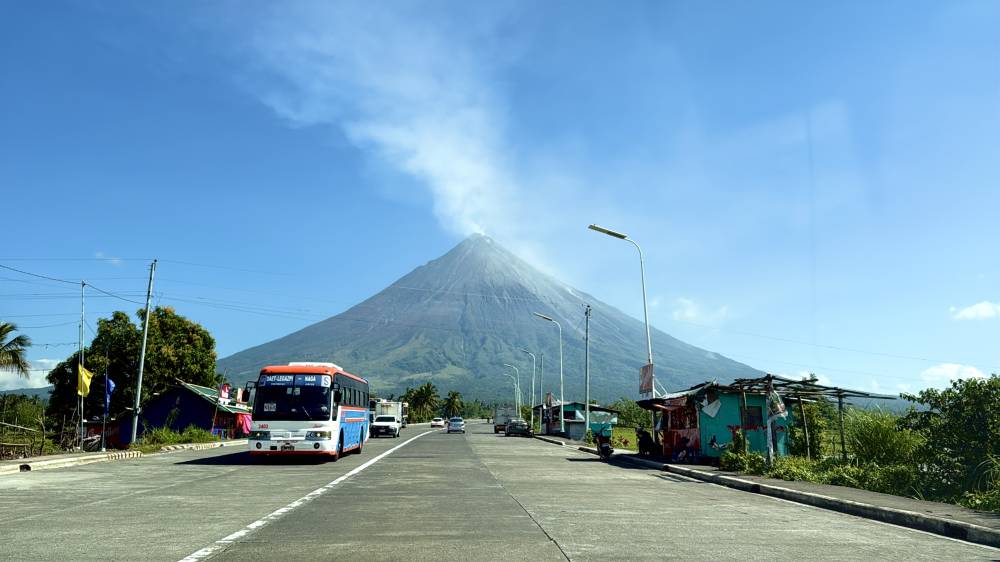
In Albay, two brief but intense PDCs at Mayon Volcano on Friday, which triggered a lava dome collapse, sent ash plumes soaring up to 3,000 meters above sea level.
Phivolcs reported that the collapses occurred in the volcano’s Bonga Gully at 12:40 p.m. and 2:05 p.m., generating rockfalls and ash emissions that drifted toward the towns of Daraga, Camalig and Guinobatan.
Despite the activity, monitoring parameters indicate that the current alert status does not need to be raised.
Doreen Abelinde, officer in charge of the Mayon Observatory Station, told the Inquirer that the volcano’s effusive eruption remains sustained, making a sudden explosive eruption unlikely. She added that a similar scenario at Kanlaon Volcano is also considered unlikely at this time.
Abelinde reiterated that entry into the 6-km PDZ remains strictly prohibited due to the hazards posed by volcanic materials.
Camalig Mayor Carlos Irwin Baldo confirmed that no ashfall was reported in the municipality and no communities were affected. —WITH A REPORT FROM MICHAEL B. JAUCIAN