










Teachers: School year plan won’t solve issues

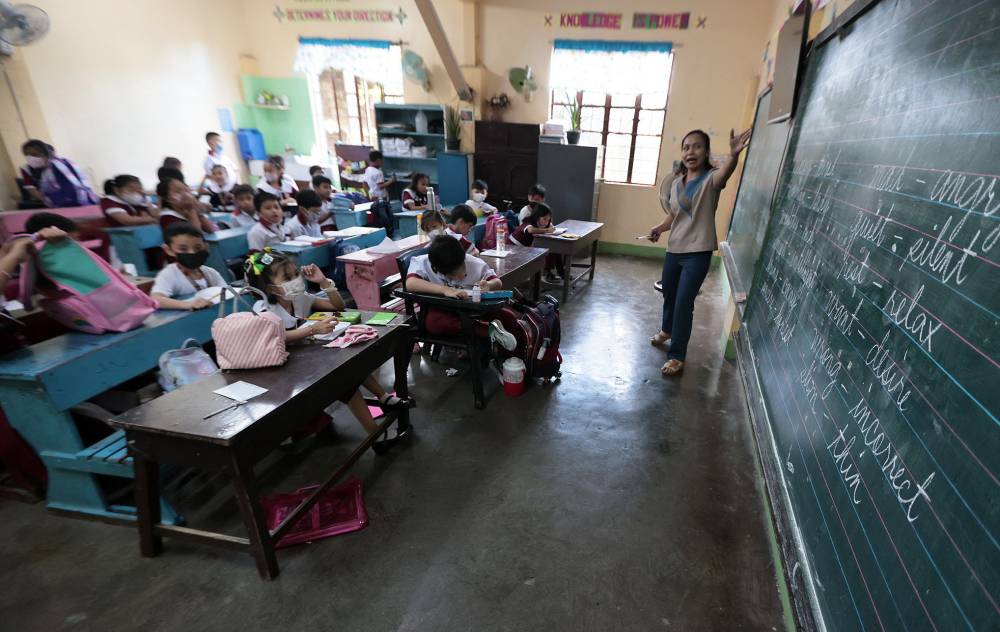
The Alliance of Concerned Teachers (ACT) urged the Department of Education (DepEd) to halt the implementation of its trimestral school year proposal and hold genuine and transparent consultations with students, parents and educators.
ACT chair Ruby Bernardo on Friday said the government has again imposed so-called “reforms” without consulting stakeholders, despite DepEd pronouncements that the new public school year proposal would undergo consultations before implementation.
Bernardo complained that the DepEd has not made public consultations on changes that would likely impose new burdens on students, parents and educators, but the Department of Economy, Planning and Development (DepDev) has announced that the proposal had already been approved by President Marcos.
“We already called for consultations, but in the end, [the changes in the school calendar] were imposed in a rush,” Bernardo said in a statement.
She also questioned how the government could conclude that the proposal would improve learning outcomes among students when there were no studies and “transparent evaluations” that were conducted to support the three-term calendar.
Drop in literacy, numeracy
The Second Congressional Commission on Education (Edcom 2) found that testing tools, such as the Early Language, Literacy and Numeracy Assessment and the National Achievement Test, show a continuing decline in Filipino students’ literacy and numeracy, which has declined sharply from Grade 3 to Grade 12, with only 30.52 percent of Grade 3 learners deemed proficient in 2024.
This rate dropped to 19.56 percent by Grade 6, 1.36 percent by Grade 10 and just 0.47 percent by Grade 12, meaning fewer than five out of every 1,000 senior high school students demonstrate expected skills, Edcom 2 reported.
According to Bernardo, the three-term school calendar will not resolve the “fundamental problems” of the country’s education system, such as classroom shortages, low wages, excessive workloads and the lack of learning materials.
The school calendar itself was neither the problem nor the root cause of the problem, she said, noting that despite numerous government-imposed changes, including the K-to-12 education system, the quality of education remains unchanged.
Bernardo said the DepEd should have laid out its proposals to stakeholders who will be affected by the changes.
Same old promises
Education Secretary Sonny Angara presented the proposal in February, claiming the new system in schools would allow “longer and more flexible instructional periods” and the reduction of workloads among teachers.
Under Angara’s proposal, classes will open in early June, with the first trimester running from June to September, followed by the second trimester from September to December and the third from January to March.
“They cannot just pass on responsibilities to implement a policy that lacks the needed preparations,” Bernardo said, noting that the K-to-12 system was implemented only after 10 years of consultations under three administrations.
The Inquirer sought Angara’s side about President Marcos’ purported approval of the three-term school calendar, but has yet to respond as of press time.
“These kinds of rushed policies are just like the K-to-12 system, which will soon face its doom while [we] educators in schools will have to find our own ways just to fill in the gaps caused by these decisions,” she said.
The K-to-12 system was first conceived and proposed in 2008 as a “transformative” system during the administration of former President Gloria Macapagal Arroyo, purportedly to align the country’s education system with the rest of the world.
The system took almost 10 years to implement during the presidencies of former President Benigno Aquino III and Rodrigo Duterte, but even more issues, including reforms in the curriculum, arose as it was implemented.