











Washington Post cuts a third of its staff

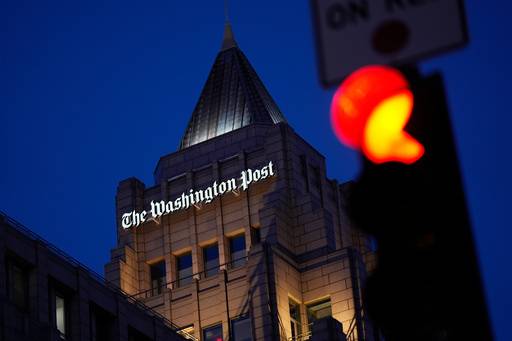
The Washington Post laid off one-third of its staff Wednesday, eliminating its sports section, several foreign bureaus and its books coverage in a widespread purge that represented a brutal blow to journalism and one of its most legendary brands.
The Post’s executive editor, Matt Murray, called the move painful but necessary to put the outlet on stronger footing and to weather changes in technology and user habits. “We can’t be everything to everyone,” Murray said in a note to staff members.
He outlined the changes in a companywide online meeting, and staff members then began getting emails with one of two subject lines—telling them their role was or was not eliminated.
Rumors of layoffs had circulated for weeks, ever since word leaked that sports reporters who had expected to travel to Italy for the Winter Olympics would not be going. But when official word came down, the size and scale of the cuts were shocking, affecting virtually every department in the newsroom.
“It’s just devastating news for anyone who cares about journalism in America and, in fact, the world,” said Margaret Sullivan, a Columbia University journalism professor and former media columnist at the Post and The New York Times. “The Washington Post has been so important in so many ways, in news coverage, sports and cultural coverage.”
Pleas for help
Martin Baron, the Post’s first editor under its current owner, billionaire Jeff Bezos, condemned his former boss and called what has happened at the newspaper “a case study in near-instant, self-inflicted brand destruction.”
And former House Speaker Nancy Pelosi called the layoffs “part of a broader reprehensible pattern in which corporate decisions are hollowing out newsrooms across the country.”
In an speech to members of the Washington Press Club Foundation, Pelosi said: “A free press cannot fulfill its mission if it is starved of the resources it needs to survive. And when the newsrooms are weakened, our republic is weakened.”
Bezos, who has been silent in recent weeks amid pleas from Post journalists to step in and prevent the cutbacks, had no immediate comment.
The newspaper has been bleeding subscribers in part due to decisions made by Bezos, including pulling back from an endorsement of Kamala Harris, a Democrat, during the 2024 presidential election against Donald Trump, a Republican, and directing a more conservative turn on liberal opinion pages.
A private company, the Post does not reveal how many subscribers it has, but it is believed to be roughly 2 million. The Post would also not say how many people it has on staff, making it impossible to estimate how many people were laid off Wednesday. The Post also did not outline its finances.
The Post’s troubles stand in contrast to its longtime competitor The New York Times, which has been thriving in recent years, in large part due to investments in ancillary products, such as games and its Wirecutter product recommendations. The Times has doubled its staff over the past decade.
Eliminating the sports section puts an end to a department that has hosted many well-known bylines through the years, among them John Feinstein, Michael Wilbon, Shirley Povich, Sally Jenkins and Tony Kornheiser. The Times has also largely ended its sports section, but it has replaced the coverage by buying The Athletic and incorporating its work into the Times website.
The Post’s Book World, a destination for book reviews, literary news and author interviews, has been a dedicated section in its Sunday paper.
A half-century ago, the Post’s coverage of Watergate, led by intrepid reporters Bob Woodward and Carl Bernstein, entered the history books. The Style section under longtime executive editor Ben Bradlee hosted some of the country’s best feature writing.

Mideast teams
Word of specific cuts drifted out during the day, as when Cairo bureau chief Claire Parker announced on X that she had been laid off, along with all of the newspaper’s Middle East correspondents and editors. “Hard to understand the logic,” she wrote.
Lizzie Johnson, who wrote last week about covering a war zone in Ukraine without power, heat or running water, said she had been laid off, too.
Anger and sadness spread across the journalism world.
“The Post has survived for nearly 150 years, evolving from a hometown family newspaper into an indispensable national institution, and a pillar of the democratic system,” Ashley Parker, a former Post journalist, wrote in an essay in The Atlantic. But if the paper’s leadership continues its current path, “it may not survive much longer.”
Fearing for the future, Parker was among the staff members who left the newspaper for other jobs in recent months.
******
Get real-time news updates: inqnews.net/inqviber