






Bonifacio’s love child in Libog, Albay


This weekend, we commemorate the 130th anniversary of the beginning of the Philippine Revolution against Spain. We remember Andres Bonifacio, his bolo, the tearing of the cedula, and the so-called “grito” or “first cry” of rebellion, which, depending on the historian you are citing, could be: “Sugod mga kapatid! (Charge, brothers!)”, “Kalayaan! (Freedom)”, or the most powerful words in the Tagalog language, best rendered here as “P.I.M.!” Clue: watch the Vice President’s “Blair Witch Project” video, where she intones P.I.M. repeatedly.
In many classrooms this month, students are required to take sides on controversial issues in Philippine history, not just what was shouted in August 1896, as physical cedulas were torn to bits. The debate is on the place: Balintawak or Pugad Lawin. The debate is on the date: Aug. 23, 24, 25, 26, 27, 28, 29, 30, and even a wild card date, Sept. 5! Unfortunately, these debates are sterile and do not involve deeper historiographical reflection. For example, the official site is currently set in Pugad Lawin rather than the traditional Balintawak.
Deeper historical understanding can be achieved if K-12 teachers stack the primary sources in favor of Balintawak against Pugad Lawin, which is based on Pio Valenzuela’s recollection of events, and the authority of the nationalist historian Teodoro A. Agoncillo. Rather than debate the dates and place-names, students are well served by analyzing the socioeconomic and cultural factors that led to the revolution. When students see how much has changed and how much has remained the same since, history prods them to contemplate radical change, not with bullets but through the ballot.
One of the light moments in the boring legalese of the ongoing impeachment trial against the Vice President was the presentation of an acknowledgment receipt signed by a certain “Xenisu P. Belat.” When the “e” is mispronounced as an “i,” the name elicits laughter, prompting the presiding officer to call for order in the court. The road from Daraga to Naga last week reminded me of a visit to the town of Santo Domingo. Before it was renamed in 1959 to honor its patron saint, Santo Domingo Guzman, founder of the Dominicans, the town was “Libog.” Bikolanos pronounce this as “lib-og,” which means hazy, unclear, “malabo.” The same word read and understood differently by Tagalogs means: lust, lewd, or lascivious. We have the same issue in the 1991 renaming of the municipality of Sexmoan, Pampanga, into Sasmuan.
I visited Santo Domingo years back to check out a monument to Andres Bonifacio in the town plaza that figured in the rumor that he fathered an illegitimate daughter there. From what I read and heard, there was a “white naturalist” who gathered specimens and conducted wildlife studies in Albay, ably assisted by his Tagalog taxidermist-valet named Andres. Fedor Jagor, a German, is ruled out: he was active from 1859-1860. Better candidates would be prominent United States period bureaucrats Dean C. Worcester or Frank Bourns, who visited the Philippines in 1890-1893, doing field work for the Menage Zoological Expedition. Another candidate, proposed by Dr. Jose Bantug, was John Foreman, whose book “The Philippine Islands” (1890) has the author on the frontispiece posed beside a half-naked “native.” Photo caption reads, “The author and his travelling servant.” To cut a long story short, “Andres” had an affair with Genoveva Baloloy, a local lass, and left her with a child—a daughter christened Francisca.
In 1897, Mayon Volcano erupted, forcing the Baloloy family, including Genoveva and little Francisca, to relocate to Irosin, Sorsogon. Sometime before the Japanese occupation, a statue honoring Bonifacio was erected in Irosin. When Genoveva saw the monument, she remembered Andres, her lover (she didn’t even remember his surname!), and claimed the man in the monument was Francisca’s father. Gossip travels faster than news, and in time, affidavits were signed and notarized, interviews were made, and a good time was had by all.
These rumors were killed by an authoritative footnote in Teodoro Agoncillo’s magisterial “Revolt of the Masses” (1956), where he declared, “There is nothing wrong in Bonifacio’s amorous escapades—if true.” Agoncillo’s research revealed that neither Foreman nor Worcester identified Bonifacio as the servant. Furthermore, Bonifacio was not anywhere near Albay in the years 1894-1895. In 1957, Elias Ataviado, an authority on the revolution in Bicol, added to Agoncillo’s accounting of Bonifacio’s whereabouts in 1894-1895, based on informants who pointed out a certain Andres Celestino, who admitted having an affair in Albay. This should definitively put to rest the fake news that Bonifacio had a love child in Albay. Francisca Baloloy’s father is not the Katipunan Supremo, but a certain Andres Celestino, a taxidermist who was said to be in the employ of the Bureau of Science in Manila.
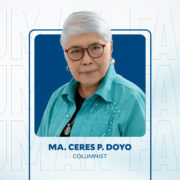
Reconstructing events from my notes for this column, I now realize I looked at the wrong monument in (Libog) Santo Domingo, Albay. I should now plan a trip to see the Bonifacio monument (if it still exists) in Irosin, Sorsogon.
—————-
Comments are welcome at [email protected]


Nature brings rain; we make floods worse