




Post-People Power 1986 stories


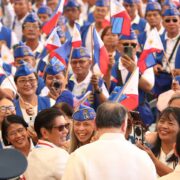
Three days ago, I posted on Facebook many photographs that I took during the four-day people power and military uprising that began in the late afternoon of Feb. 22, 1986 inside Camp Aguinaldo where members of the media, I among them, brushed elbows with putschists bristling with ammunition and I was waiting for bombs to fall and bullets to fly. People power began the following day after then Manila Archbishop Cardinal Jaime Sin called for people to troop to Epifanio de los Santos Avenue (Edsa) and it ended on Feb. 25 with the toppling of the 14-year Marcos dictatorship. The Armed Forces of the Philippines’ Camp Aguinaldo and the Philippine Constabulary’s Camp Crame are face to face along Edsa.
The 1986 People Power was a defining moment for Filipinos that awed the world. People power was not confined to Edsa. Populated centers in other parts of the Philippines held their own. Documentaries and movies have been made, many books and thousands of articles have been written about that one shining, defining moment. Forty years later, here and now, where we are, is another story. What led up to where we are now is an even longer story. But it still feels good to recall how we basked in the afterglow of those momentous events. This week, I have been rummaging through my photo files and articles, mainly written for the Sunday Inquirer Magazine (SIM) where I became a staff writer right after the 1986 People Power phenomenon. Almost every year after 1986, the magazine published an anniversary issue. (Because I am still writing for the Inquirer until today, I can say that I should also celebrate my 40th in this paper. The Inquirer began as a weekly two months before the snap elections that led to the 1986 people power event.)
Right after the 1986 dismantling of the dictatorship, I was assigned to fly to Tacloban City, Imelda Marcos’ home province, to look into the remnants of her opulent lifestyle and what she had amassed and left behind. The resulting article was “Don’t cry for me, Tacloban City.”
I was also assigned to see and write about what Malacañan Palace looked like right after its occupants had fled and been airlifted by United States forces to safety in Hawaii. The SIM editor at that time was Letty Jimenez-Magsanoc whom we fondly called LJM (later editor in chief of the Philippine Daily Inquirer until 2015 when she left for The Great Newsroom in the Sky). She it was who had edited the feisty Mr. & Ms. Special Edition published by Eggie Apostol, Inquirer founding chair. I had also written for the Special Edition that chronicled the events after the Aug. 21, 1983 assassination of former Sen. Benigno “Ninoy” Aquino Jr. The paper sold in the streets like hotcakes. No doubt the guns of August had signaled the so-called beginning of the end. Who knew then that it would be in 1986?
LJM had a penchant for long titles for feature articles. So the title of my piece on the Malacañang that the Marcoses left behind was “Come one, come all, see where our money went, see the Marcos extravaganza 20 years in the making with a cash of billions” and for the sidebar piece, “‘Our home is not even 1/3 of Imelda’s toilet,’” uttered by someone from the so-called “Great Unwashed” who were allowed to roam around the palace. Photo credits go to Bullit Marquez and Willy Vicoy.
One year later in 1987, I was assigned to track down and do a story on the two Daughters of Saint Paul nuns who were photographed facing the military tank deployed to smash people power and flatten those in the way. The piece’s title: “Flattening experience: The picture that went around the world.”
Excerpts from that story:
She must have been on the “Hail …” of the Hail Mary when the camera clicked Sunday afternoon Feb. 23 which explains Sr. Porfiria (Pingping) Ocariza’s open mouth. The grim looking nun beside her is Sr. Teresita (Terry) Burias who has her right hand and rosary under her left elbow.
“We were praying the Sorrowful Mysteries of the Holy Rosary when the photo was taken … That was already our second rosary. After the first, the tanks moved back … Then a new wave of tanks came … When I saw the tanks coming, I said to myself, Para kaming nasa karnabal. Ano kaya ang itsura namin kung flat na kami?” (It was like being in a carnival. I wondered, what would we look like after we have been flattened?)

As a people, we know how we have been flattened by corruption over these past four decades, by the excesses of those who held power, save for the leaders who really cared and delivered sans froth in the mouth and braggadocio and then were gone. But at present, we are in the maw of so many monsters, in the grip of so many ogres who roam the land, who rule with impunity and regale the poor, vulnerable, and gullible with their carnival-like roadshows.
The people’s rising call: “Mga kurakot, i-kulong na yan.” We are getting there. This time, we pray, we do it right. True justice comes ever so slowly but it will come like a rolling boulder for the plunderers, murderers, and their enablers.
—————-
Send feedback to cerespd@gmail.com