









Pampanga property’s acceleration and evolution


Pampanga is one of the most competitive real estate houses outside Metro Manila.
This is understandable, given the developers’ strong confidence in Kapampangans’ rising purchasing power and growing affluence, supported by the expansion of business activities across outsourcing, manufacturing, retail, and leisure segments.
Having been born, raised, and educated in Pampanga, I have personally witnessed the evolution of its property market. Over the years, I saw the launch of masterplanned communities, which are more expansive than the standalone office and residential towers developed in the past.
From a property analyst’s perspective, this is hardly surprising as national players need to serve the evolving demands of large office occupiers and affluent residential investors.
Pampanga property’s ascension
Pampanga is a property hotspot that covers all bases.
It has a growing outsourcing sector; a thriving retail sector attracting national mall developers; a burgeoning leisure segment attracting foreign hospitality brands and integrated resort developers; a bustling industrial sector that entices foreign manufacturing brands; and a dynamic residential sector.
With all these exciting built and upcoming projects, Colliers believes that property firms should continue exploring parcels of developable land viable for office, residential, retail, and leisure projects.
These may include commercial lots strategically situated in active markets such as Angeles City as well as emerging residential sub-locations such as Porac which is gaining reputation as a popular residential enclave within Pampanga.
Improving connectivity, thriving economy
Pampanga is located in Central Luzon, which remains a major economic hub outside Metro Manila.
The region’s services sector accounted for 47 percent of its economic output, followed by industry and agriculture. The performance of these segments indicate the strong growth of outsourcing and manufacturing activities within and outside Clark Freeport.
Pampanga’s property landscape has substantially evolved over the years, with national players aggressively landbanking in the province, particularly in Angeles, San Fernando, Mabalacat, and Porac.
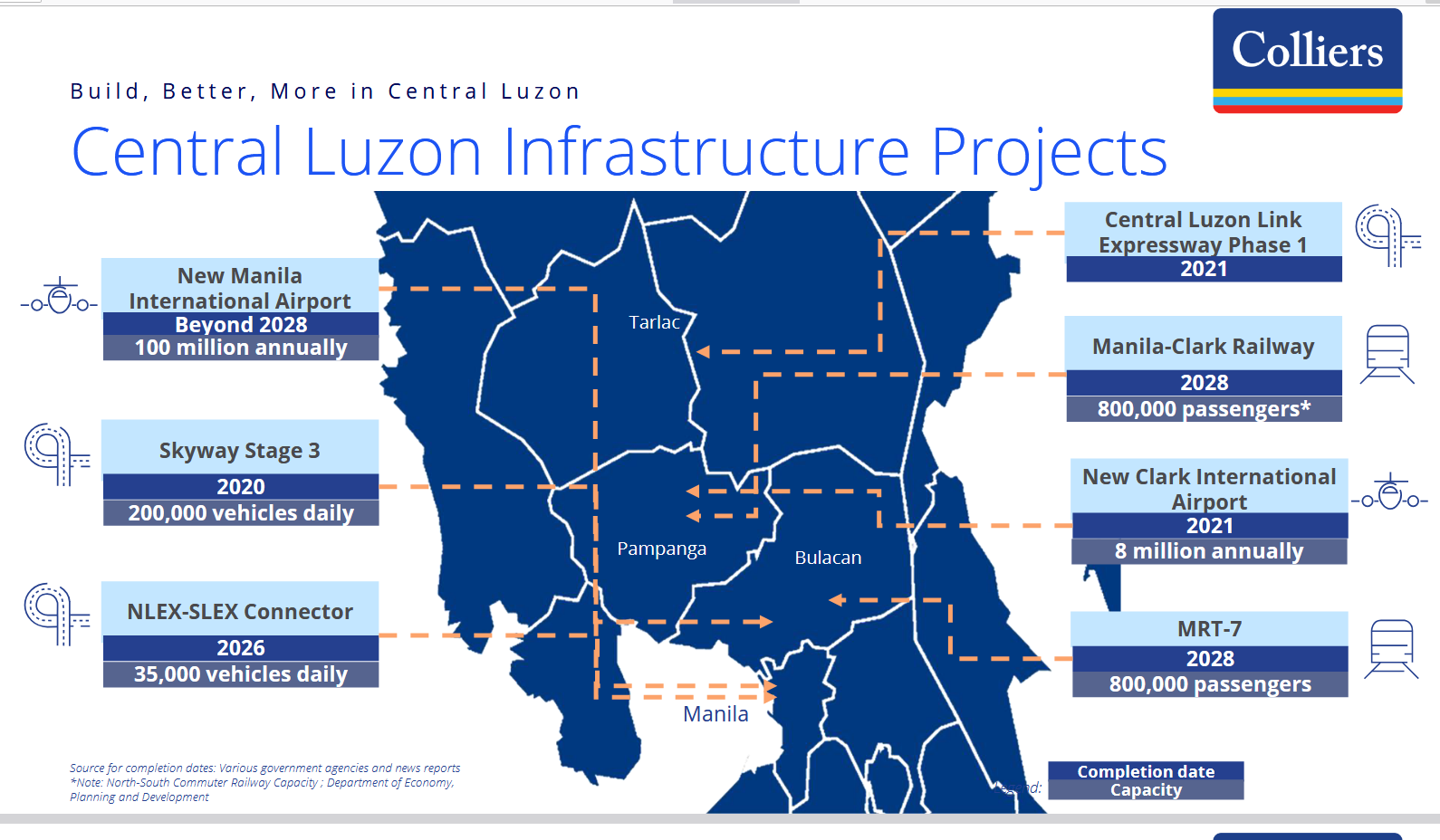
In the near to medium term, Pampanga’s attractiveness as a preferred property hub outside Metro Manila should be sustained by key infrastructure projects in the pipeline, such as the North-South Commuter Railway and the Central Luzon Link Expressway.
Angeles and Porac are among the areas likely to benefit, while already enjoying proximity to the recently expanded and modernized Clark International Airport.
Thriving residential enclave
Pampanga has the largest condominium stock in Central Luzon. As of 2025, its supply reached 5,400 units, with average take-up at 87 percent as of Q4 and average prices at P206,000 per sqm per unit.
In recent years, property firms have also tested the appetite for upscale and luxury condominium developments (at least P12 million per unit). With improving connectivity and the rising affluence of Kapampangans and even Metro Manila investors, Colliers is optimistic that developers will continue to test the viability of more expensive condominium projects in Pampanga.

In 2025, demand for house-and-lot (H&L) units in Pampanga was driven by economic and affordable projects (P580,000 to P3.2 million), particularly those in the towns of Magalang, Santa Ana, and the cities of Angeles, Mabalacat, Mexico and Porac. As of Q4 2025, average take-up of H&L projects in Pampanga was 89 percent.
From 2016 to 2025, lot only projects in Central Luzon recorded a 5 percent annual average price increase. Prices of some specific projects even appreciated faster than the regional average.
For instance, lot prices in Alveo Land’s Aldea Grove Estates in Angeles, Pampanga grew by 8 percent yearly from 2019 to 2025. Meanwhile, prices of residential lots within Ayala Land’s Alviera in Porac recorded an annual average price appreciation of 11 percent from 2017 to 2025.
In our view, lot-only projects are attractive given their large cuts; greener and more open spaces; and these features should support further price acceleration.
Demand for commercial lots
Colliers Philippines believes that the aggressive evolution of Pampanga’s real estate market is compelling property firms to explore other projects that will enable them to corner demand from local and foreign businesses.
The continued inflow of remittances into Pampanga should help drive demand for retail spaces, including showphouses in the region.
We see the active retail market in Pampanga as well as continued growth of its economy resulting in a demand for more commercial lots where malls, hospitals, schools, hotels, and other support establishments can be developed.
These commercial lots will also be viable for other institutional and commercial projects given the Pampanga’s rising population and acceleration of natives’ disposable incomes.